Product Description
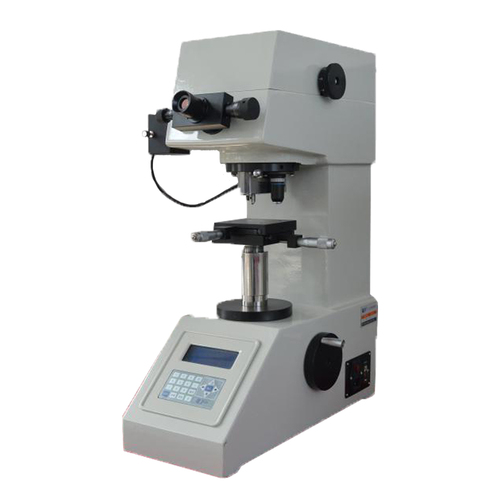
Micro Vickers Hardness Tester 200HV-5
Application:
It's suitable to determine the Vickers hardness of steel, non-ferrous metals, ceramics, treated layers of metal surface, and the hardness grads of carburized, nitrided and hardened layers of metals. It is and also suitable to determine the Vickers hardness of micro and super thin parts.
Main features:
Weight direct load-type Vickers integrated machine, high precision;
LCD hardness display, high precision optical measurement system;
CCD image processing system optional;
The test force covers the microscopic and Vickers test requirements;
Equipped with precision coordinate test bench;
Precision conforms to the Standards of GB/T 4340.2, ISO 6507-2 and ASTM E92.
Specifications:
Measuring range: 5-3000HV
Test scale: 1.961,2.942,4.93,9.807,19.61,25.52,29.42,49.03N (0.2,0.3,0.5,1.0,2.0,2.5,3,5kgf)
Magnification: 400x;100x
Min test unit: 0.25mm
Test force dwelling time: 0-99s
Max height of specimen: 130mm
Throat depth: 110mm
Size of XY coordinate worktable: 100x100mm
Travel of XY coordinate worktable: 25x25mm
Resolution of xy coordiante worktable: 0.01mm
Optical source: 12v/20w
Language: Chinese /English
Power supply: AC220V 50HZ/60HZ
Overall dimension: 486x337x657mm
Weight: 68kg
High-Precision Microhardness MeasurementThe 200HV-5 delivers consistent and reliable micro Vickers hardness values, ranging from 5 to 3000 HV, allowing for accurate testing of diverse sample types. Its 0.01 m resolution and adjustable dwell times provide flexibility for researchers, while compliance with ISO and ASTM standards ensures trustworthy data for quality assurance and laboratory analyses.
User-Friendly Operation and VersatilityThis tester offers both automatic and manual control modes, a digital LCD display, and a smooth XY stage with 25 mm travel. With a selection of test loads and objective lenses, the instrument adapts to varying sample requirements. The clear optical path is supported by a bright, adjustable LED, enabling optimal observation through the eyepiece or screen.
FAQ's of Micro Vickers Hardness Tester 200HV-5:
Q: How does the Micro Vickers Hardness Tester 200HV-5 operate?
A: The tester uses variable test loads and precise dwell times to create microscopic indentations on specimens. These indentations are then measured using high-clarity eyepieces and objective lenses (100x for viewing, 400x for measuring) alongside a built-in ocular micrometer. Automated and manual modes simplify operation for different user preferences.
Q: What materials or applications is this tester suitable for?
A: The 200HV-5 is ideal for measuring the microhardness of thin, small, or hard materials found in metallurgy, research labs, or industrial quality control. It is routinely applied to metal coatings, electronic components, and other fine materials requiring low-load Vickers hardness testing.
Q: When should different test loads be selected?
A: Use the selectable test loads (5-2000 gf) based on specimen thickness and hardness. Softer or thinner samples generally require lower loads, while harder or thicker materials can withstand higher loads without risk of excessive deformation.
Q: Where is the indentation measurement observed and recorded?
A: Indentations are observed using the 100x or 400x objective lenses and measured through the eyepiece with a built-in micrometer. Data can be digitally output via a screen, ensuring accurate readings are easily documented and transferred using the USB/RS232 interface.
Q: What is the process of calibrating the 200HV-5 Micro Vickers Hardness Tester?
A: Calibration involves using the provided Vickers diamond indenter and calibration blocks. The tester should be calibrated regularly to maintain accuracy and compliance with ISO 6507 and ASTM E384 standards. Calibration is backed by clear digital feedback from the LCD display.
Q: How can users benefit from the automatic turret and LED illumination features?
A: The automatic turret enables seamless objective lens switching for efficient workflow, while the adjustable LED ensures consistent illumination and optimal visibility of tiny indentations under all laboratory lighting conditions.
 English
 Spanish
 French
 German
 Italian
 Chinese (Simplified)
 Japanese
 Korean
 Arabic
 Portuguese











 Send Inquiry