Product Description
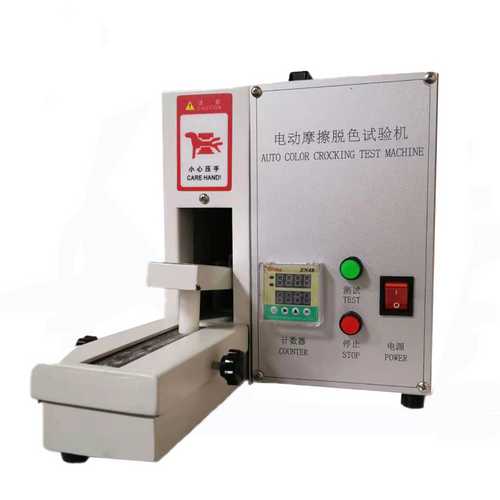
HT-3920 Rubbing Friction Color Fastness Tester
The electronic crockmeter applies to textiles, knitted fabrics, leather, power of metal plates, printing and other industries. Evaluation of friction test for color fastness. Therefore available to the routine testing of production and scientific research units and the development of standards. This instrument uses advanced technology, with automatic control circuit, and is more advanced at home and abroad friction color fastness instrument. And versatile, reciprocating frequency can be set.
Application
Electronic textile crockmeter / rubbing fastness tester applies to textiles, knitted fabrics, leather, power of metal plates, printing and other industries.
Standards
1. GB/T3920-97 color fastness of textiles abrasion test method
2. GB/T5712-97 organic solvent-resistant textile friction color fastness test method
3. GB/T420-90 printing and dyeing cloth scrub fastness test method
Technical Parameter
Friction head pressure: 9N
Friction head diameter: 16mm
The number of crank rotation: 60 times/min
The number of controlled reciprocating: 0-99999 times(optional)
Friction head trip: 100mm
Maximum size and thickness of the sample: 220x110x5mm
Motor power: 40w
Dimension: 760x270x240mm
Weight: About 15Kg
Reliable Color Fastness TestingThe HT-3920 Crockmeter offers precise and repeatable friction testing to evaluate the durability of colors on textiles. Its sturdy MS construction combined with electric operation ensures consistent outputs, essential for quality control across different sectors.
Broad Application RangeWhether deployed in hospital labs or textile factories, the HT-3920 suits multiple settings where color longevity under friction is essential. Its operational flexibility and broad voltage compatibility make it a dependable choice internationally.
FAQ's of HT-3920 Crockmeter Rubbing Friction Color Fastness Tester:
Q: How is the HT-3920 Crockmeter Rubbing Friction Color Fastness Tester used in laboratory settings?
A: The tester is employed to assess the color fastness of textile samples by applying controlled rubbing action, helping determine color resistance during actual usage. Laboratories use it for standardized testing protocols.
Q: What are the key features that distinguish the HT-3920 model?
A: The HT-3920 stands out for its reliable performance, durable MS construction, electric operation, adjustable voltage range (110-215V), and established quality, making it suitable for rigorous hospital and laboratory applications.
Q: When should the HT-3920 Crockmeter be maintained or checked for performance?
A: Routine maintenance is recommended based on the frequency of use, typically every six to twelve months, to ensure accurate, consistent results and optimal machine longevity.
Q: Where can the HT-3920 Crockmeter Tester be sourced or purchased?
A: The unit is available through distributors, exporters, manufacturers, suppliers, and traders in China who cater to both domestic and international requirements.
Q: What is the testing process with the HT-3920 Crockmeter?
A: The process involves mounting a fabric sample, applying specified force, and subjecting the material to controlled rubbing cycles while measuring resultant color transfer or fading, in compliance with standardized methods.
Q: What benefits does the HT-3920 provide to users in the textile industry?
A: The tester enables efficient quality control, ensuring textile products meet required fastness standards, reducing risk of customer complaints or returns, and boosting confidence in product durability.
 English
 Spanish
 French
 German
 Italian
 Chinese (Simplified)
 Japanese
 Korean
 Arabic
 Portuguese










 Send Inquiry