Product Description
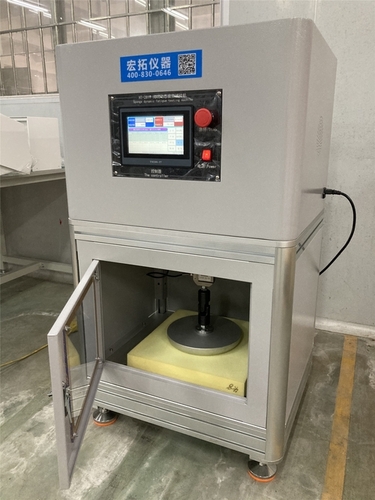
Sponge Foam Dynamic Fatigue Compression Testing Machine
Overview
This machine is used to test the thickness loss and hardness loss test of the fatigue performance of flexible foam polymer materials.
Specification
1. The number of test cycles is 80,000 times, but the test cycle number of this instrument can reach 100,000 times, and it is equipped with an automatic adjustment device. Other specifications meet the QB/T 2819-2006 standard
2. Control method: touch screen control
3. Induction method: precision load cell
4. Test force value range: 0-200kg can be set
5. Unit switching: Kg, N, LB
6. Upper pressure plate: diameter 200mm, bottom rounded corner R1mm
7. Lower platform: 420x420mm, vent diameter 6mm, spacing 20mm
8. Maximum stroke: 200mm
9. Testing speed: 100mm/min
10. Range of test times: 1-999999 times, configurable
11. Power source: servo motor
12. Transmission mode: precision ball screw
13. Power supply: single-phase 220V, 50Hz/60Hz
14. Equipment weight: about 160kg
Reliable Dynamic Fatigue TestingThis machine ensures comprehensive assessment of sponge and foam resilience through dynamic compression testing. Built from premium stainless steel, it withstands demanding industrial environments and delivers consistent, repeatable results. Its straightforward controls allow for efficient operation and versatile testing protocols, making it invaluable for manufacturers aiming for high-quality, long-lasting sponge products.
Optimized for Industrial UseWeighing 160 kilograms and equipped with a 220-volt AC power supply, this testing equipment is tailored for industrial laboratories and manufacturing facilities. By accurately replicating real-life fatigue stress on materials, it helps manufacturers evaluate product performance, resulting in better designs and increased customer satisfaction. Robust engineering ensures longevity and minimal downtime.
FAQ's of Sponge Foam Dynamic Fatigue Compression Testing Machine:
Q: How does the Sponge Foam Dynamic Fatigue Compression Testing Machine operate?
A: The machine functions by applying repeated compression loads to a sponge or foam sample, simulating the stresses it would experience during prolonged use. This process helps evaluate the material's durability and its ability to withstand dynamic fatigue over time.
Q: What materials can be tested with this machine?
A: The machine is specifically designed to test sponges and foam materials, allowing manufacturers to assess their longevity and structural integrity under cyclic compression. It is ideal for any application where sponge material durability is critical.
Q: When should you use dynamic fatigue testing for sponges or foam?
A: Dynamic fatigue testing is most beneficial when evaluating the performance of sponge or foam products that will undergo repeated compression during their use, such as bedding, upholstery, or industrial padding. Testing before product launch ensures reliability and quality.
Q: Where is this testing machine manufactured and distributed?
A: The Sponge Foam Dynamic Fatigue Compression Testing Machine is manufactured in China and distributed, exported, and supplied globally through several trusted channels, including suppliers and traders specialized in laboratory and industrial testing equipment.
Q: What is the typical process for using the testing machine?
A: To use the machine, a specimen of sponge or foam is placed between the compression platens. The machine is programmed to apply cyclic compressive loads for a set number of cycles, simulating prolonged use. After the test is complete, the operator analyzes changes in thickness, density, and other relevant properties.
Q: What are the main benefits of dynamic fatigue testing for sponges and foams?
A: Dynamic fatigue testing provides valuable insights into the durability and resilience of sponge and foam materials, allowing manufacturers to improve product design and reduce failure rates. It ultimately helps ensure high-performance, long-lasting products for end-users.
Q: How is the machine powered, and what is its construction material?
A: This testing machine operates on a 220-volt alternating current (AC) power supply and is constructed from durable stainless steel, ensuring excellent reliability and easy maintenance in busy industrial environments.
 English
 Spanish
 French
 German
 Italian
 Chinese (Simplified)
 Japanese
 Korean
 Arabic
 Portuguese











 Send Inquiry