Product Description
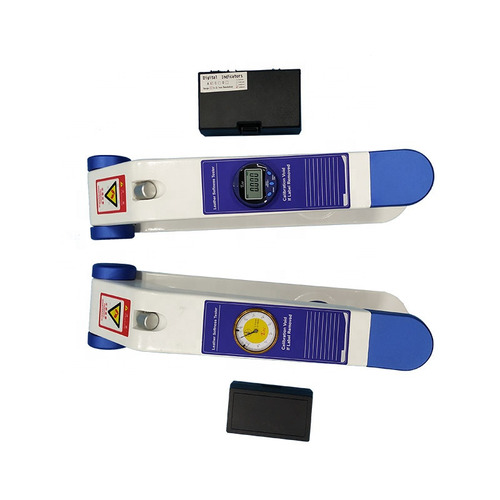
Portable Leather Softness Tester Leather Softness Machine
Application:
Measure the softness of leather and animal skins to know whether the softness and hardness of the same batch of leather is uniform or the softness difference of each part of a single piece of leather.
Standards:
IULTCS.IUP 136
Specification:
Model: HT-136
Load: 530g(by a small pneumatic control value drive)
Amount table: 0.1-10mm
Volume: 136*485*168mm
Weight: 5.3kg
ConfigurationStandard Test ring diameter 20mm and 25 mm each one
Precision Softness Testing on the GoEngineered for portability and precision, this leather softness tester provides exact measurements of leather, synthetic leather, and textiles. With a sturdy stainless steel and corrosion-resistant body, it is designed to withstand frequent use in varied environments. Manual operation and an analog dial gauge make it user-friendly, while the compact construction and foam-lined case make it easy to transport for quality assessments wherever needed.
User-Friendly Manual OperationOperating the device is straightforward: simply secure a single specimen larger than 70x70 mm using the rubber-coated clamps and manually initiate the 10 mm test stroke. The adjustable calibration knob enables quick recalibration for ongoing accuracy, and response time is instantaneous. Its design allows anyone to perform professional-grade leather softness testing without specialized training.
FAQ's of Portable Leather Softness Tester Leather Softness Machine:
Q: How does the Portable Leather Softness Tester operate?
A: This device operates manually, using a hand-applied test stroke of 10 mm after a single specimen (greater than 70x70 mm) is secured between rubber-coated clamps. The analog dial gauge displays immediate readings in Newton (N) or grams (g), allowing direct softness measurement without the need for batteries or external power.
Q: What materials and applications is this tester suitable for?
A: The tester is suitable for measuring the softness of leather, artificial leather, and fabrics, making it ideal for industries such as footwear, upholstery, automotive, and leather goods manufacturing. It ensures compliance with ISO 17235, guaranteeing standardized testing results.
Q: When should calibration be performed on the tester?
A: Calibration is recommended before each series of tests or whenever environmental conditions change significantly. The built-in adjustable calibration knob allows for quick and precise manual calibration to maintain measurement accuracy.
Q: Where can I use the Portable Leather Softness Tester?
A: Due to its robust, corrosion-resistant construction and portable design, the tester can be used in laboratories, factories, warehouses, or on-site at supplier locations. The foam-lined transport case makes it convenient and safe to carry between different work environments.
Q: What is the process for testing leather softness with this equipment?
A: Begin by placing a clean, flat specimen (minimum size 70x70 mm) between the clamps. Manually perform the test stroke while observing the dial gauge for the softness reading. Record the value in Newton (N) or grams (g) as required for your application.
Q: How does using this tester benefit manufacturers and suppliers?
A: The portable design and straightforward operation allow for quick, accurate on-site quality checks, reducing turnaround time and costs. Its ISO 17235 compliance ensures results align with industry benchmarks, supporting consistent quality control and informed sourcing decisions.
 English
 Spanish
 French
 German
 Italian
 Chinese (Simplified)
 Japanese
 Korean
 Arabic
 Portuguese









 Send Inquiry