Product Description
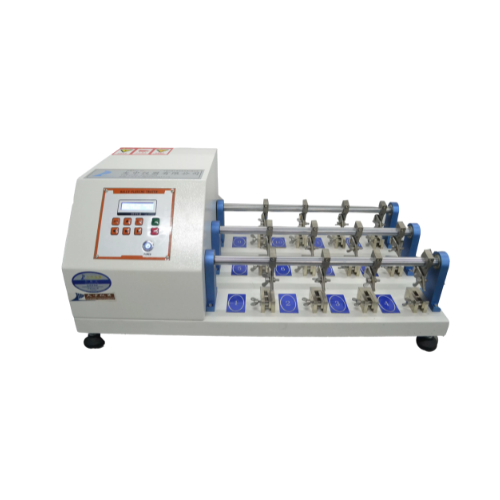
Bally Leather Flexing Tester Leather Flexoemeter for Shoes Cloth DH-LF
Summary
Leather scratch resistance tester is used to test the folding performance of various leathers and fabrics. Materials need to be nipped both inside and outside, twist and turn over and over again until a certain times, and cBally Leather Flexing Tester for Flexometer Test, Bally Leather Flexing Testerhecking the damage of the tested materials. The machine is mainly used in clothing, shoes, bags, etc.
Standards
ISO 17232 (IULTCS/IUP 38): Leather -- Physical and mechanical tests -- Determination of heat resistance of patent leather
ISO 20344: Personal protective equipment -Test methods for footwear
SATRA TM55: FLEXING RESISTANCE OF UPPER MATERIALS - BALLY FLEXOMETER
DIN 53351: Testing Of Artificial Leather And Similar Shut Materials - Behaviour At Permanent Folding
ISO 5402-1: specifies a method for determining the wet or dry flex resistance of leather and finishes applied to leather.
BS EN 344-1: Safety, protective and occupational footwear for professional use - Requirements and test methodsJIS K 6545: Testing method for flexing endurance of light leathers and their surface finishes
QB/T 2714: Leather - Physical and mechanical tests - determination of flex resistance
EN 13512: Footwear - Test Methods For Uppers And Lining - Flex Resistance
ETC...
Application
Used to test leather performance in shoes, clothing, luggage handbag industry, research laboratories; commodity inspection, arbitration and technical supervision departments.
Technical characteristics
Product name: Electronic Leather Scratch Resistance Testing Machine
Speed: 100 cpm
Fixture: 12 groups
Specimen Size: (70*45) mm
Bending Angle22.5 degree
Weight: About 60kg
Size: (52*64*40) cm
Power: AC220V, 50H
Advanced Flexing Resistance TestingThe Bally Leather Flexing Tester is engineered to provide highly accurate and consistent measurements of flex resistance in leather, shoes, and textiles. Its programmable features and easy panel interface make operation intuitive and efficient, supporting quality control and research needs. Automated cycle counting and instant LCD digital readout enhance productivity during extensive test routines.
Durable and Reliable ConstructionConstructed with stainless steel specimen holders and a heavy-duty frame, the DH-LF model ensures long-lasting performance even under frequent usage. Designed for benchtop mounting, it suits laboratories, workshops, and industrial settings, reliably handling up to 12 specimens per run for comprehensive flex tests.
FAQ's of Bally Leather Flexing Tester Leather Flexoemeter for Shoes Cloth DH-LF:
Q: How does the Bally Leather Flexing Tester assess flex resistance in materials?
A: The Bally Leather Flexing Tester evaluates flex resistance by repeatedly bending specimens (up to 12 at a time) at a controlled test speed of 100 5 cycles per minute, using a programmable and automatic digital system to replicate real-world stress conditions. Results are measured via an LCD digital display for precise cycle counts and flexing distances.
Q: What materials and products can be tested with this Flexoemeter?
A: This flexing tester is suitable for assessing leather, shoes, and textile fabrics. It provides valuable data on durability and flexibility, aiding manufacturers and suppliers in optimizing material selection for footwear and garment production.
Q: When should flex resistance testing be performed using this equipment?
A: Flex resistance testing is recommended during product development, quality control, and routine manufacturing audits. It helps ensure that materials like leather and textiles meet specified performance standards for endurance and flexibility before reaching consumers.
Q: Where is the Bally Leather Flexing Tester typically installed and operated?
A: It is designed for indoor operation and is commonly installed in laboratories, quality assurance departments, R&D centers, and production facilities due to its benchtop mounting and manageable footprint (800 400 360 mm).
Q: What is the process for conducting tests with this equipment?
A: The process involves placing up to 12 specimens (each 70 45 mm) into the stainless steel holder, inputting test parameters, and starting the programmable test cycle. The automatic system records flex cycles and provides instant digital feedback. Test results are easily retrieved from the LCD display.
Q: How does the use of this tester benefit manufacturers and suppliers?
A: Employing the Bally Leather Flexing Tester allows manufacturers to verify material durability, avoid faulty production, and meet international standards. This aids in ensuring product quality, reducing returns, and improving customer satisfaction.
 English
 Spanish
 French
 German
 Italian
 Chinese (Simplified)
 Japanese
 Korean
 Arabic
 Portuguese











 Send Inquiry