Product Description
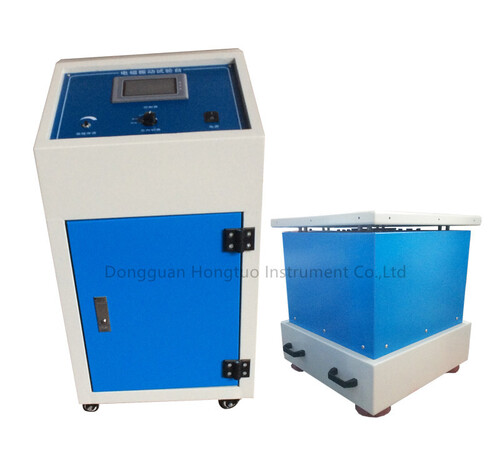
D Series Electromagnetic Program-controlled Vibration Table 1-600HZ (Vertical + Horizontal + Front and Rear)
Application:
Electromagnetic vibration table are widely used in industries such as defense, aviation, communications, electronics, automobiles, home appliances, and others. This type of equipment is used to find early faults, simulate actual working conditions and structural strength tests. The product has a wide range of applications, wide application areas, and significant and reliable test results. Sine wave, frequency modulation, frequency sweep, programmable, frequency doubling, logarithmic, time control.
Features:
1. Using the most advanced and simple operation technology, fixed frequency, frequency sweep, easy to switch the program at any time
2. With time timing, countdown display function
3. Touch controller, simple and convenient operation, solve the shortcomings of inconvenience of digital display operation
4. The control parameters are displayed synchronously in real time without manual intervention.
5. The base of the machine adopts vibration isolation device, which is easy to install and runs smoothly, without the need to install anchor fixing screws
6. Embedded amplitude prediction program and easy amplitude modulation
7. Four-point synchronous vibration, uniform table vibration
8. Stepless adjustment of amplitude, fixed frequency and frequency sweep operation functions adapt to various test requirements in different industries
9. Add anti-interference circuit to solve the interference of the control circuit due to strong electromagnetic field
10. Curve display function, can view the frequency waveform changes at any time
11. Curve supports direct export function
12. Automatic switching of working direction
Specification:
Test load:60KG
Vibration direction: Vertical + horizontal + front and back (automatically switching)
Table size (mm): 500*500
Amplitude (P-P): 0-5mm (random, change with frequency, adjustable)
Frequency sweep: 1-600HZ can be set arbitrarily (true standard back and forth frequency sweep)
Maximum acceleration: 20g
Indicator function: FM, frequency sweep, timei program
Programmable function: 5-600HZ, 1-8 segments can be arbitrarily set frequency and time
Accuracy: Frequency can be displayed to 0.1Hz, precision 0.1Hz
Vibration waveform: Sine wave
Time control: Time can be set
Power: 1.2KW
Advanced Testing for Diverse ApplicationsThe D Series Electromagnetic Vibration Table is designed to address the demanding needs of quality control and safety evaluation in modern industries. Its ability to simulate various transport conditions, along with user-friendly programmable features, enables comprehensive testing for electronics, automotive, and packaging products. The platform helps to ensure reliable product performance under real-world vibration environments.
Precision and Flexibility in Vibration SimulationsEngineered for accuracy and flexibility, the vibration table provides a frequency range of 1~200 Hz with 0.01 Hz resolution and 0.1 Hz precision. The electromagnetic linear motor ensures smooth, stable, and repeatable test cycles, while adjustable settings for test speed, stroke, and programmable test time make it suitable for both standard and customized test protocols.
Safety, Durability, and User ConvenienceSafety mechanisms, including overload and overcurrent protection, coupled with an easy-to-maintain anti-corrosion stainless steel surface, provide lasting durability and operational reliability. The table operates quietly and features simple digital controls, LCD display, and connectivity via RS232/USB, ensuring safe, convenient, and efficient testing for every user.
FAQ's of D Series Electromagnetic Vibration Table Vibrating Test Platform:
Q: How does the D Series Electromagnetic Vibration Table simulate various transportation environments?
A: This test platform features programmable controls and adjustable vibration parameters (frequency, amplitude, and speed), enabling it to mimic vibrations experienced during road, rail, or sea transport. Users can set precise test profiles to evaluate product performance under different simulated conditions.
Q: What types of specimens and industries can benefit from this vibration test table?
A: The system is suitable for electronics, automotive, and packaging industries. It can accommodate up to four specimens at a time, with each specimen measuring up to 400x400 mm and a combined weight of 100 kg, offering reliable testing for a broad range of products.
Q: When should I use this vibration table in my product evaluation process?
A: It is ideal to use this platform during product development and quality assurance phases, especially when assessing resistance to transportation-induced vibrations. Early testing helps identify vulnerabilities, ensuring product robustness before final deployment or shipment.
Q: Where can the D Series Electromagnetic Vibration Table be installed and used?
A: This floor-standing equipment is suitable for laboratory, manufacturing, or quality inspection environments. It runs on standard single-phase 220V AC supply and does not require compressed gas, making installation straightforward in most standard industrial spaces.
Q: What is the process for setting up and controlling vibration tests on this machine?
A: Operators use the digital controller and LCD display to input test parameters such as frequency, test time, and stroke. The machine supports programmable modes, enabling customized or standardized test cycles. Once set, the system will automatically execute the test according to user-defined protocols.
Q: How does the table ensure safety and operational reliability during testing?
A: Built-in overload and overcurrent protection systems help safeguard both specimens and equipment. Forced air cooling maintains optimal operation temperatures, while the anti-corrosion stainless steel surface ensures long-term durability.
Q: What are the main benefits of using this electromagnetic vibration table?
A: Users benefit from low-noise, precise, and stable operation, as well as the ease of setting complex vibration profiles. The machine's programmable automation capabilities and compatibility with multiple transport simulation scenarios ensure comprehensive product evaluation, helping reduce the risk of damage during actual shipping or handling.











 Send Inquiry