Product Description
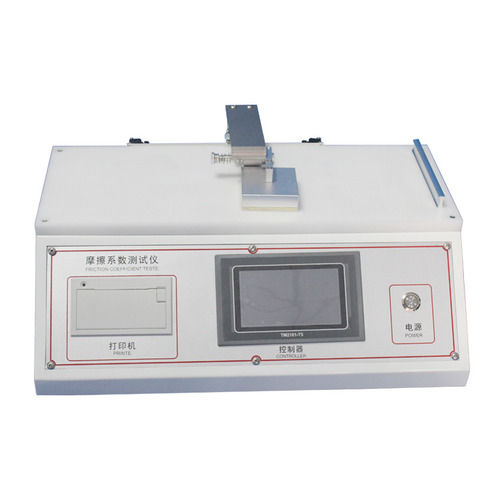
COF Tester Coefficient of Friction Tester Meter
Application:
The friction coefficient tester is developed for the determination of static and dynamic friction coefficients of plastic films and sheets when sliding on the surface of themselves or other materials. It can meet GB/T1006-1988 "Plastics-Film and Sheet-Determination of Friction Coefficient".It is an ideal test equipment for quality inspection departments and production enterprises at all levels, and can provide you with accurate test results.
Specification:
Farmar weight(g): 200 g
Slider moving speed(mm/min): 100
Test force accuracy(N): 0.02
Power supply(AC): 220V, 50Hz
Maximum size of specimen(mm): Upper sample 63*63
Lower sample80*200
Dimensions (width x length x height)(mm): 300x400x180
Weight(kg): 10
Advanced Performance and Reliable PrecisionDesigned for laboratory and industrial applications, this COF tester guarantees high accuracy and consistency with 0.01 COF repeatability and a 0.001 N resolution. The microcomputer-controlled system enables automated operations, efficient data management, and swift, reliable testing for various material types, ensuring consistently precise results.
Intuitive Operation and Versatile Data HandlingWith digital LCD display, USB/printer output, and RS232 interface, the tester streamlines the data collection process. Operating at 220V AC, it accommodates a test width of 80 mm and specimen size of 80 mm x 200 mm, making it suitable for different laboratory and industrial settings requiring friction measurement.
Safety, Compliance, and Build QualityFeaturing overload protection, emergency stop mechanisms, and compliance with leading standards (ASTM D1894, ISO 8295, TAPPI T816), this instrument prioritizes user safety and measurement reliability. Its powder-coated metal frame and table-top design ensure durability without compromising ease of use.
FAQ's of COF Tester Coefficient of Friction Tester Meter:
Q: How does the COF Tester measure static and kinetic coefficient of friction?
A: The COF Tester utilizes a precision motorized drive to slide a sled of standard (or custom) weight across a specimen. It digitally measures the force required to initiate and maintain movement, providing both static and kinetic coefficient of friction values.
Q: What kinds of materials can be evaluated using this instrument?
A: This tester is designed for a variety of materials such as plastic films, sheets, paper, and similar substrates, complying with standards like ASTM D1894, ISO 8295, and TAPPI T816 for accurate and universal results.
Q: When should external standard weight calibration be performed?
A: Calibration using external standard weights is recommended before initial use, after any significant relocation, and at regular intervals as specified in your quality control protocols to ensure ongoing measurement accuracy.
Q: Where is this equipment most suitable for installation and operation?
A: The COF Tester should be set up in a laboratory or industrial environment that is clean, dry, and free from vibrations. Its tabletop design and ambient noise level below 60 dB(A) make it ideal for controlled testing spaces.
Q: What is the process for conducting a COF test with this meter?
A: To perform a test, prepare your specimen to the specified size, calibrate the device, set the appropriate test mode (static or kinetic), and mount the sample on the table. The sled will move at a test speed of 100 mm/min while the instrument records and displays test data automatically.
Q: How does the tester ensure safety during operation?
A: Safety is enhanced with built-in overload protection and an emergency stop function, preventing equipment damage and protecting personnel during operation.
Q: What are the key benefits of using this COF testing instrument?
A: Benefits include high accuracy (1% of reading), repeatability (0.01 COF), automatic statistical analysis, flexible data output options, compliance with international standards, robust construction, and user-friendly operation-making it a reliable choice for quality control and product development.
 English
 Spanish
 French
 German
 Italian
 Chinese (Simplified)
 Japanese
 Korean
 Arabic
 Portuguese











 Send Inquiry