Product Description
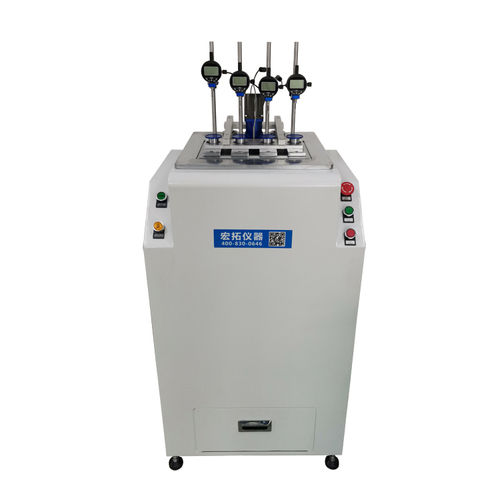
HDT / Vicat Softening Point Temperature Tester
Application:
This machine is a non-metallic material testing instrument designed and manufactured according to the latest international standards and national standards. It is mainly used for non-metal such as plastic, hard rubber, nylon, electrical insulating materials, long fiber reinforced composite materials, high strength thermosetting laminates. Determination of the heat distortion temperature of the material and the Vicat softening point temperature. It is easy to operate and precise in control. It is a highly intelligent test instrument widely used in colleges and universities, research institutes and product quality supervision and inspection units. It adopts single-chip control, PID phase-modulated output, with upper limit temperature setting, and automatically stops heating when the test temperature reaches the upper limit temperature.
Standards:
GB/T1633 "Determination of vicat softening temperature (VST) of thermoplastics"
GB/T1634 "Determination of plastic load deflection temperature part 1: general test method"
GB/T8802 "Determination of softening temperature of plastic pipe fittings"
IS075-2013 "Determination of plastic load deformation temperature"
ASTM D 648 "Plastic heat deflection temperature test method"
ASTM D 1525 "Plastic vicat softening temperature test method"
Advantages:
1.Intelligent PID adjustment, accurate heating rate, precise temperature control
2.Can do thermal deformation test of various standard specimen
3.Can do Vicat softening point test of various standard specimen
4.The required load can be automatically calculated according to the test standard and sample size
5.Two heating rates can be selected, free switching, simple operation
6.When the test is completed or the temperature exceeds the upper limit, the temperature control will be turned off and shut down automatically
7.With software over-temperature protection and leakage protection
8.Has air-cooled and water-cooled dual rapid cooling
Specification:
Temperature control range: ambient temperature-300 degree
Temperature indication error: 0.1 degree
Deformation measurement range: 0-10mm
Number of sample racks: 4
The weight of the load bar and the tray: 76g
Test span range: 64 or 100mm according to the standard
Fuel tank volume: about 13L
Heating medium: methyl silicone oil
Cooling method: built-in active air cooling or external water cooling
Heating power: 1.5kw
Appearance size: length 60cm*width 50cm*height 132cm
Precision Testing for Plastics and PolymersDesigned for laboratories, manufacturers, and quality control, the HDT/Vicat tester delivers accurate measurement of heat distortion and softening temperatures. Programmable settings and instant response time simplify testing procedures, while the digital display ensures easy data interpretation. Its compliant design supports multiple international standards, making it suitable for global applications.
User-Friendly Operation and Enhanced SafetyEquipped with automatic microprocessor control, quick-release clamps, and intuitive software, the tester streamlines specimen setup and test execution. The electronic overheat cut-off with audible alarm, plus IP20 rated enclosure, guarantee operator safety and equipment durability. Bench-top mounting allows convenient placement in varied laboratory environments.
Comprehensive Data Management and ReportingUp to 100 test records can be stored, with direct data output through RS232 for integration with external PC software. This enables detailed report generation and historical data tracking, helping users meet documentation and regulatory requirements efficiently. Calibration is simple and user-performed, ensuring consistent measurement accuracy.
FAQs of HDT / Vicat Softening Point Temperature Tester:
Q: How does the HDT/Vicat Softening Point Temperature Tester determine the softening temperature of plastics?
A: The tester uses standardized test methods to heat specimens at a programmable rate of 50C/h in a silicone oil bath, while measuring the temperature at which material deforms under a defined load. Indenter tips and automatic microprocessor control ensure precise results for both HDT and Vicat tests.
Q: What types of plastics and polymer specimens can be tested with this equipment?
A: This tester accommodates standard-sized specimens, such as HDT (125 x 13 x 3 mm) and Vicat (10 x 10 x 3 mm), making it suitable for a wide variety of plastic and polymer materials used in research, manufacturing, and quality assurance testing.
Q: When should I calibrate the HDT/Vicat tester and what is the calibration process?
A: Calibration should be performed periodically following reference standards or before critical testing sessions. Users can calibrate the equipment themselves using supplied calibration weights and reference materials, ensuring continued measurement accuracy.
Q: Where can the HDT/Vicat Softening Point Temperature Tester be installed for operation?
A: Its bench-top mounting design and IP20 rated enclosure allow safe and stable installation in laboratory environments, quality control rooms, or manufacturing facilities. The equipment is robust and does not require special gas supplies.
Q: What is the benefit of having programmable heating rates and automatic microprocessor control?
A: Programmable heating rates and automatic microprocessor control reduce operator intervention, streamline workflow, and improve repeatability. These features enhance test reliability and allow consistent results across multiple specimens and sessions.
Q: How does the tester manage data and reports for test results?
A: Test results are stored within the equipment (up to 100 records) and can be exported via RS232 interface to PC software for comprehensive report generation, facilitating traceability and compliance with regulatory standards.
 English
 Spanish
 French
 German
 Italian
 Chinese (Simplified)
 Japanese
 Korean
 Arabic
 Portuguese










 Send Inquiry