Product Description
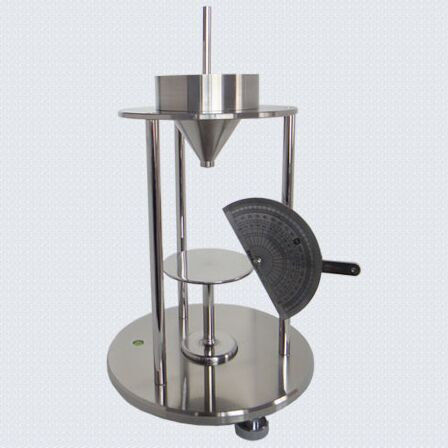
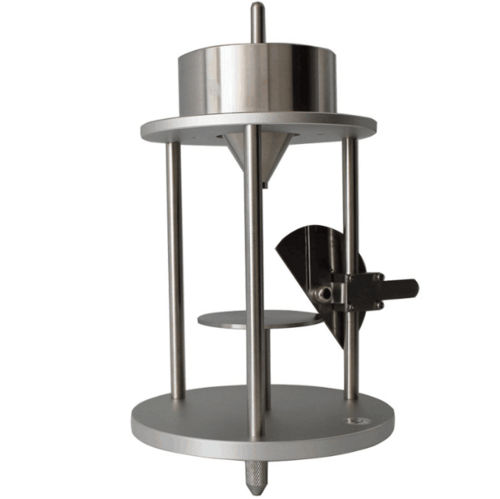
Repose Angle Tester
The angle of repose is the angle (relative to the horizontal base) of the conical pile produced when a granular material is poured on to a horizontal surface. It is related to the density, surface area and coefficient of friction of the material concerned.
DF-1-05 repose angle tester is designed and produced based on ISO 4324:1997.
Structure:
(1)Funnel(diameter of outflux:5mm)
Taper of funnel: 60 degree
(2)Protractor
10cm
(3) Chassis
The distance between chassis and outflux: 80mm
Diameter of tray: 80mm
(4)Repeated error: less than or equal to 1%
Advanced Angle Adjustment SystemEquipped with a stepper motor and fine-tune control, the Repose Angle Tester allows precise setting of test angles from 15 to 75. The adjustable chute and collector tray facilitate easy specimen placement and collection, enhancing test repeatability and efficiency. Both manual and automatic modes provide flexibility for varied testing requirements.
Laboratory-Grade Safety and ComplianceSafety is prioritized with overload protection and an emergency stop switch. The instrument is compliant with ISO 4324:1997 and ASTM C1444 standards, ensuring reliable powder flowability measurements. Compact and bench-top mountable, it fits seamlessly into laboratory workflows, supporting routine and research testing alike.
Efficient Data Logging and CalibrationRecord up to 500 test results with the built-in memory, assisting in data management and traceability. The device is factory calibrated for immediate use but supports manual calibration for specific protocols, enabling accuracy to 0.5 and a resolution of 0.1. Calibration and result retrieval are intuitive via the digital LCD display and RS232 interface.
FAQs of Repose Angle Tester:
Q: How do I operate the Repose Angle Tester safely in a laboratory environment?
A: To ensure safe usage, always connect the tester to a standard AC 220V, 50 Hz power supply, and operate it indoors within 540C and 2090% RH. Use the overload protection and emergency stop switch during testing. The compact, bench-top design keeps it stable during operation.
Q: What is the primary process for measuring the angle of repose using this equipment?
A: To measure the angle of repose, place up to three specimens (100 mm diameter, 5500 g capacity) on the chute. Adjust the test stroke and angle using the stepper motor controls. The material is released onto the collector tray, and the built-in digital LCD displays instantaneous readings with a response time under one second.
Q: When should I perform manual calibration, and how is it done?
A: Manual calibration is recommended before critical measurements or after extended use to ensure optimal accuracy. The process involves following the supplied calibration instructions, adjusting the system via the control interface, and verifying results against reference standards. Factory calibration also provides reliable initial settings.
Q: Where can the Repose Angle Tester be used, and what are its typical applications?
A: The device is designed for use in indoor laboratory environments, supporting the measurement of powder and granular material flowability for research, quality control, and industrial analysis. It is widely utilized by manufacturers, suppliers, and research laboratories involved in powder processing.
Q: What are the key benefits of using the Repose Angle Tester over manual measurement methods?
A: This tester offers superior accuracy (0.5), rapid response (<1 s), automated angle adjustment, and comprehensive data logging. Its compliance with international standards and user-friendly features, such as a digital display and dual operation modes, streamline laboratory workflows and improve result reliability.
Q: How is test data stored and retrieved from the device?
A: Test results are automatically stored in the built-in memory, capable of holding up to 500 test entries. Data can be retrieved from the digital LCD display and exported via the RS232 interface for further analysis or record keeping.
 English
 Spanish
 French
 German
 Italian
 Chinese (Simplified)
 Japanese
 Korean
 Arabic
 Portuguese










 Send Inquiry