Product Description
Summary
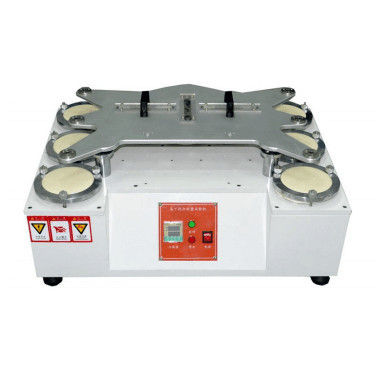
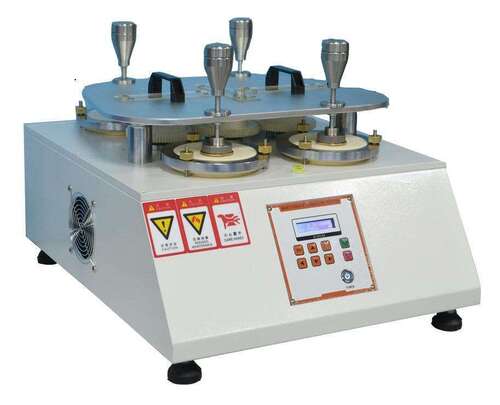
Martindale abrasion tester subjects a circular specimen (38mm in diameter, and effective diameter is 28.8mm) to a defined load and rubs against an abrasive medium (i.e. standard fabric) in a translational movement tracing a Lissa-jous figure. The specimen holder, containing either specimen or abrasive medium depending on which method is being used, is additionally freely rotatable around its own axis perpendicular to the plane of the horizontal. The evaluation of the abrasion resistance of the textile fabric is determined from the inspection interval to breakdown, the mass loss the test specimens, assessment of the appearance change.
Standards
GB/T21196-2007,GB/T4802.2-2008,GB/T13775,FZ/T20020,ASTM D4970,ISO12945-2ASTM D4966,ASTM D3886,ISO12947,JIS
L1096,IWS,TM196,TM112,M&S.
Application
Used for testing the performance of the wearing resistance, abrasion, appearance change (pilling degree/class) of the textiles and membrane materials.
Technical characteristics
- Number of working position: 6
- Counter range: 0-99999
- abrader speed:50-2r/min
- instrument size:885x600x410mm
- power supply:Ac220V 50Hz 500W
- weight:150kg
Advanced Testing for Textile DurabilityThe Martindale Abrasion and Pilling Tester is engineered to deliver reliable durability assessments across textiles and fabrics. Its automatic counting system and ability to test up to nine samples at once streamline laboratory workflows, ensuring efficiency and accuracy. This machine fully complies with recognized international standards, making it suitable for quality assurance and product development in the textile industry.
Intuitive Digital Control and PrecisionA user-friendly digital touch panel makes operation straightforward, allowing operators to set test cycles and monitor progress in real time. The testers high-resolution display offers instant feedback, while its ability to automatically stop at the completion of set cycles safeguards both specimens and machine components.
FAQs of Martindale Abrasion and Pilling Tester:
Q: How does the Martindale Abrasion and Pilling Tester evaluate textile durability?
A: The tester assesses fabric durability by subjecting samples to controlled abrasion and pilling motions (Lissajous movement) under specified loads. The digital system counts cycles until your preset target, automatically stopping to ensure compliance with chosen standards.
Q: What are the machines application areas and main benefits?
A: Its primarily used for testing abrasion and pilling resistance in textiles and similar materials. Key benefits include programmable operation, high-precision measurement, multi-station testing (up to 9 samples simultaneously), and ease of use via digital menu control.
Q: When should I use customizable test loads, and how are they set?
A: Customizable test loads (9 kPa/12 kPa or as required) should be chosen based on the specific standard or textile type being tested. The test loads are applied using the included loading weights and adjusted according to standard methods laid out in your testing protocol.
Q: Where can the Martindale Tester be installed and what are its space requirements?
A: The tester is designed for bench-top mounting and fits into most laboratory settings. Its approximate dimensions are 850 x 600 x 430 mm (L x W x H), and it weighs about 75 kg, making it suitable for textile labs, manufacturing control rooms, or quality assurance departments.
Q: What is the typical testing process with this equipment?
A: The testing process involves preparing fabric specimens, installing them in the sample holders, selecting the test parameters (load, cycles, stations), and initiating the test using the touch panel. The machine operates automatically, recording cycles and stopping at completion.
Q: What accessories come standard with this Martindale Tester?
A: Essential accessories included are sample holders, loading weights, abrading fabric, and extra spares, ensuring users have everything needed for immediate operation and maintenance.
Q: How does the digital system enhance testing accuracy and efficiency?
A: The digital display provides real-time cycle counts with 1 cycle accuracy and an immediate response, reducing the likelihood of errors and manual monitoring, while the auto-stop function protects samples and improves consistency in results.
 English
 Spanish
 French
 German
 Italian
 Chinese (Simplified)
 Japanese
 Korean
 Arabic
 Portuguese










 Send Inquiry