Product Description
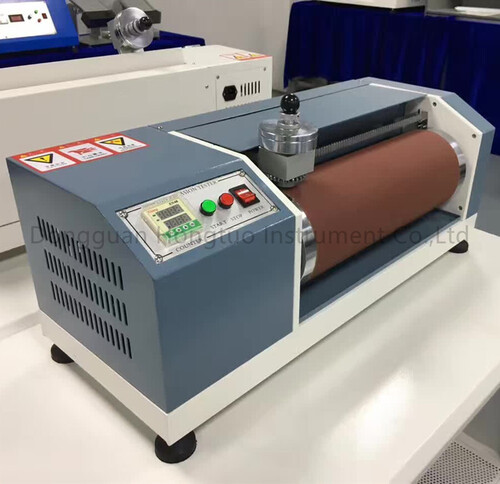
DIN Leather Abrasion Resistance Tester
Application
Suitable to determine the wear resistance of elastic material, rubber, tires,conveyor belts,shoe soles, soft synthetic leather and other materials.
Standards
DIN-53516,ISO/DIS-4649,GB-9867
Principle
Under a predetermined contact pressure and a given area,the specimen with sandpaper angled to measure abrasion resistance of the specimen subjected to rubbing on a certain level of sandpaper, sandpaper affixed to the surface of the drum, samples pressed on a drum with sandpaper, and the specimen along the roller to the lateral movement, abrasion resistance is produced at one end of the cylindrical specimen, tests the value of the mass loss of the specimen, by the density of the specimen to calculate the amount of volume abrasion.
Specifications
- Roller diameter:150mm
- Roller length:460mm
- Rotate speed:40rpm
- Abrasion stroke:40mm(20mm)
- Abrasion speed:0.32m/sec
- Dip angle:3 degree
- Specimen diameter:16 mm
- Thickness:6 -15 mm
- Testing load:5N,10N
- Clamp horizontal displacement:4.2mm/roll each lap
- Standard accessories:one set of sampler,two pieces of abrasive
Precision Leather Abrasion TestingEngineered to provide precise and repeatable abrasion resistance measurements, this tester leverages a 90W drive motor and a hard-wearing 50 mm abrader wheel (57-63 HRC). The machines robust design and digital counter ensure reliable data for up to 50,000 test cycles, supporting both manual and automatic control modes for flexibility in testing processes.
Easy Operation and Reliable StandardsOffering a user-friendly interface and easy specimen clamp system, this tester simplifies the workflow for laboratory staff. Complying with DIN 53516 and ISO 4649 standards, it ensures global compatibility and reliable test results for international trade requirements.
Versatility for Industrial ApplicationsPerfect for distributors, exporters, manufacturers, suppliers, and traders, especially those based in China, this abrasion tester is optimized for testing leather but can be adapted for various other materials. Its powder-coated finish and bench-top design allow seamless integration in most laboratory environments.
FAQs of DIN Leather Abrasion Resistance Tester:
Q: How does the DIN Leather Abrasion Resistance Tester determine material durability?
A: The tester evaluates durability by subjecting a leather specimen to controlled abrasion using a 50 mm abrader wheel under specified loading weights (2 N or 5 N). The process continues up to 50,000 cycles, and the digital counter precisely records the number of cycles until visible wear appears or failure occurs.
Q: What standards does this abrasion resistance tester comply with?
A: This model is compliant with DIN 53516 and ISO 4649 standards, ensuring that test procedures and outcomes are recognized internationally for material quality assessments.
Q: When should I use this tester in the manufacturing process?
A: It is ideal to use the tester during product development, quality assurance, and before shipment to ensure that leather goods meet required abrasion resistance criteria and are suitable for long-term use.
Q: Where is this equipment most effectively used?
A: The tester is designed for laboratory and quality control departments in manufacturing facilities dealing with leather and similar materials. Its bench-top format makes it suitable for spaces with limited room, common in both small and large-scale operations.
Q: What is the routine process for conducting a test with this equipment?
A: To perform a test, clamp the specimen using the knurled ring, select the desired loading weight, set the test parameters on the electronic counter, and commence testing using manual or automatic mode. The machine will then abrade the sample for the set number of cycles and display the results on the digital counter.
Q: How does using this tester benefit my business operations?
A: Implementing this tester in your workflow ensures products meet industry durability requirements, reduces the risk of returns due to quality issues, and enhances customer confidence by providing verifiable test reports for your leather goods.
Q: What accessories are provided, and how do they support the testing process?
A: Included accessories such as a brush, standard abrasive paper, and sample templates streamline sample preparation and improve testing accuracy, ensuring repeatable and standardized results every time.
 English
 Spanish
 French
 German
 Italian
 Chinese (Simplified)
 Japanese
 Korean
 Arabic
 Portuguese









 Send Inquiry