Product Description
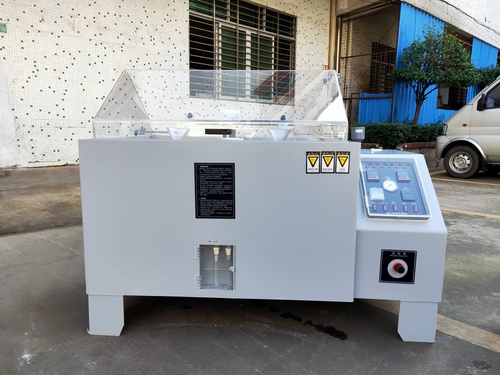
Laboratory Salt Spray Test Chamber Salt Mist Resistance Tester
Features:
The salt spray test chamber uses salt spray corrosion method to detect the reliability of the corrosion resistance for the tested samples,Salt fog refers to the dispersion system composed of tiny droplets of salt in the atmosphere. It is one of the instrument for three kinds of artificial environmental protection (Moist heat,salt mist,bacteria) Many companies need to test out the destructive effect on the products by simulate marine climate,that why comes out the salt spray testing chamber.The machine can be classified as neutral salt and acid salt.the difference is based on the testing standards and testing method.respectively called "NSS" and "CASS" testing.
This product meets the standards of CNS, ASTM, JIS, ISO, etc.The salt spray test is to test the corrosion resistance of the surface of various materials after coating, electroplating, anodizing, anti-rust oil and other anti-corrosion treatment.
Standards:
CNS3627,3885,4159,7669,8886,JISD-0201,H-8502,H-8610,K-5400,Z-2371,ISO 3768,3769,3770,ASTMB-117,B-268,GB-T2423,GJB 150
Material:
- 5MM imported gray and white impact resistant P.V.C board, high temperature resistance up to 85 degree, corrosion resistance.
- Support shelf:10MM glass fiber rod, corrosion resistance.Plastic-steel V-shaped brackets and fiber rods is placed at an angle to ensure that the test object is inclined at 15-30 degrees.
- Pressure bucket adopts seamless welding by 2.0MM SUS304 stainless steel plate.
- Using titanium alloy heating tube for heat generation, long service life, high corrosion resistance.
- The cover is made up of 5MM imported transparent (Germany YLIS) acrylic board. Fine workmanship, beautiful appearance, high transparency.
Specification:
Model: DHL-90
Volume:270L
Interior dimensions(mm)L*W*H:900*600*500
Exterior dimensions(mm)L*W*H:1400*850*1200
Sealing method: The inside and outside box is connected to the sealing groove, using water sealing. avoid salt spray leakage.
Temperature range:
1: Laboratory temperature: 35-50 degree(can be set arbitrarily)
2: Pressure bucket temperature:47-63 degree(can be set arbitrarily)
Power: AC220V 50HZ 15A
Precise Corrosion Testing for LaboratoriesThis chamber excels at simulating harsh salt mist environments for evaluating corrosion resistance. Its adjustable parameters and programmable timer offer flexibility for a wide array of materials, ensuring accurate, repeatable results. A clear acrylic lid allows easy observation during testing without compromising containment or environmental integrity.
User-Friendly Automation and SafetyWith semi-automatic operation, programmable controls, and built-in safety features such as water shortage and over-temperature alarms, this tester prioritizes ease of use and operator protection. Automatic distilled water replenishing and instant defogging enhance continuous testing procedures with minimal user intervention.
Durable Construction and Versatile CapacityCrafted from fiberglass reinforced plastic and high-density PVC, the chamber resists corrosion and wear. Its capacity accommodates a diverse range of specimen sizes and up to 30 samples simultaneously, making it an efficient choice for research, quality control, and development labs.
FAQ's of Laboratory Salt Spray Test Chamber Salt Mist Resistance Tester:
Q: How do I operate the Laboratory Salt Spray Test Chamber?
A: Operation is simple with the chamber's microcomputer controls and digital touchscreen display. Set the desired testing parameters, add the 5% NaCl salt solution to the 15-liter tank, load up to 30 specimens onto the corrosion-resistant holders, and start the cycle. The chamber can run continuous or intermittent spray modes and provides instant feedback and safety alerts.
Q: What types of tests can be performed with this salt spray chamber?
A: This chamber supports various test types, including Neutral Salt Spray Test (NSS), Copper-Accelerated Acetic Acid Salt Spray (CASS), and Acetic Acid Salt Spray (ACSS). These methods assess the corrosion-resistant properties of coatings and materials under controlled salt mist conditions.
Q: When should I use the continuous vs. intermittent spray modes?
A: Continuous spray is typically used for standard corrosion resistance tests that require constant salt exposure, while intermittent spray is preferred for cyclic or accelerated testing, simulating alternating environmental conditions as specified by certain industry standards or research protocols.
Q: Where should the test chamber be installed?
A: The chamber should be set up in a well-ventilated laboratory or dedicated materials testing area, with an ambient temperature between 5C and 35C. Ensure the installation site can support the chamber's 80 kg weight and dimensions, and provides access to a 220V AC power supply and standard 1/4 air inlet.
Q: What is the process for maintaining the salt spray test chamber?
A: Routine maintenance includes cleaning the specimen holders, salt solution tank, and spray nozzle (glass) after use. Check for over-temperature or water shortage alarms, and use the automatic distilled water replenishing feature to prevent operation interruptions. Regularly inspect and replace consumables as needed for optimal performance.
Q: How does this chamber benefit laboratories and manufacturers?
A: It delivers precise, repeatable results for corrosion resistance, aiding product development, quality control, and compliance with international standards. Its robust construction, ease of use, and programmable automation minimize operator workload and maximize productivity.
Q: Can test parameters such as time, temperature, and spray rate be adjusted?
A: Yes, all key parameters-testing time (up to 9999 hours), temperature (35C 1C for NSS or 50C 1C for CASS), and spray rate (1-3 ml/80cm2/h)-are adjustable through the digital interface, ensuring test conditions can be tailored to specific requirements.
 English
 Spanish
 French
 German
 Italian
 Chinese (Simplified)
 Japanese
 Korean
 Arabic
 Portuguese










 Send Inquiry