Product Description
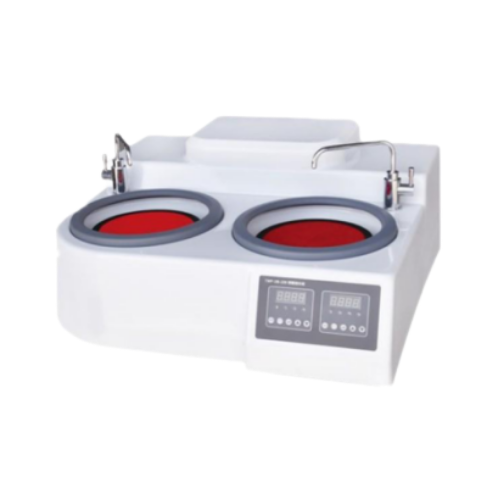
Dual Motor Control Grinding Polishing Machine for Metallographic Analysis
Main Features:
This grinding and polishing machine is a double-disc dual-control desktop machine, suitable for coarse grinding, fine grinding and polishing of the sample, and can meet two person working together. The machine adopts micro-processing system, double-disc can be directly achieve separately 50-1000 rpm speed and 150 and 300 rev / min two-speed, so that the machine has a wider range of applicability.With cooling device, it could cool the specimen while pre-grinding so as to avoid over heat to damage the metallographic organization .Convenient use, safe and reliable, it is the idea equipment of making specimen for the factories, research units , universities and collages.
Specifications:
Working voltage: 220V 50HZ
Polishing disc diameter: 220mm
Input power: 220V 50HZ
Dimension: 720*740*370mm
Weight: 50kg
Precision Dual Motor SystemThis grinder polisher utilizes dual independent 370 W motors, allowing for simultaneous or individual control of each spindle. This feature enables greater flexibility, supporting a wide range of metallographic sample preparation tasks while ensuring efficient throughput and error reduction during workflow.
Integrated Water Cooling and SafetyEquipped with standard quick-connect water inlet and rear outlet, the machine maintains optimal cooling and debris removal during grinding or polishing. Safety mechanisms, such as overload and thermal protection, along with a transparent polycarbonate cover, safeguard both users and specimens throughout the operation.
Flexible Application and User-Friendly OperationDesigned for laboratories and industrial settings, this bench-top semi-automatic machine caters to samples measuring 30-50 mm in diameter. Its manual and touch key controls, digital LED display, and interchangeable pads make setup, operation, and maintenance straightforward, supporting an adjustable test stroke and specimen capacity up to two at a time.
FAQ's of Dual Motor Control Grinding Polishing Machine for Metallographic Analysis:
Q: How does the dual motor control benefit metallographic sample preparation?
A: The dual motor design allows for independent control of each grinding or polishing spindle. This enhances versatility and process efficiency, enabling simultaneous processing or different operations on separate samples, leading to reduced preparation time and improved consistency.
Q: What is the process for cooling during grinding and polishing?
A: The integrated water cooling system uses a standard quick-connect inlet and rear outlet for effective water delivery and drainage. This maintains a controlled temperature, minimizes thermal damage to specimens, and removes debris, ensuring optimal grinding and polishing results.
Q: When should I change the grinding paper or pad?
A: Change the grinding paper or pad when you notice decreased abrasiveness, visible wear, or surface contamination that could affect sample quality. The machine's design with self-adhesive or magnetic 230 mm papers and interchangeable pads makes replacing consumables straightforward and quick.
Q: Where can this machine be used, and what applications is it suited for?
A: This grinding polishing machine is ideal for laboratory and industrial metallography environments, including research institutes, factories, and quality control labs. It excels in grinding and polishing metallographic specimens for microstructural analysis in materials science and engineering.
Q: How do I operate the machine and adjust speed or direction?
A: Operation is managed through a manual or touch key interface and a digital LED display. Users can independently control each motor, adjust the speed in increments of 1 rpm within the 50-600 rpm range, and select the spindle rotation direction (clockwise or counterclockwise) based on process requirements.
Q: What safety features are included in the equipment?
A: The machine is equipped with overload and thermal protection to prevent motor damage, as well as a transparent polycarbonate cover for user safety. These features contribute to secure and reliable operation, even during extended use.
Q: What are the benefits of using this grinding polishing machine for metallographic analysis?
A: The machine offers precise speed control, dual motor efficiency, enhanced sample throughput, easy consumable changeover, and robust safety features. Its water cooling system ensures optimal surface finish and prevents overheating, supporting accurate, repeatable specimen preparation for reliable metallographic analysis.
 English
 Spanish
 French
 German
 Italian
 Chinese (Simplified)
 Japanese
 Korean
 Arabic
 Portuguese










 Send Inquiry