Product Description
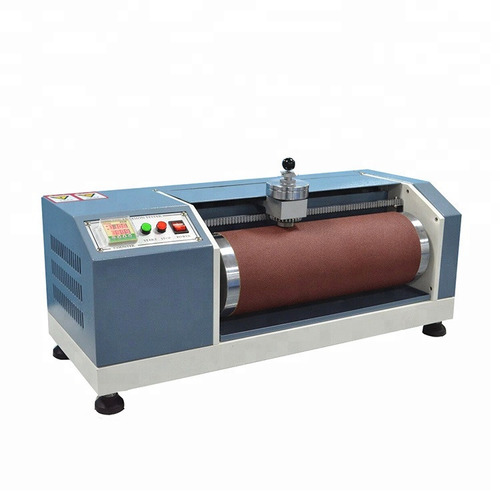
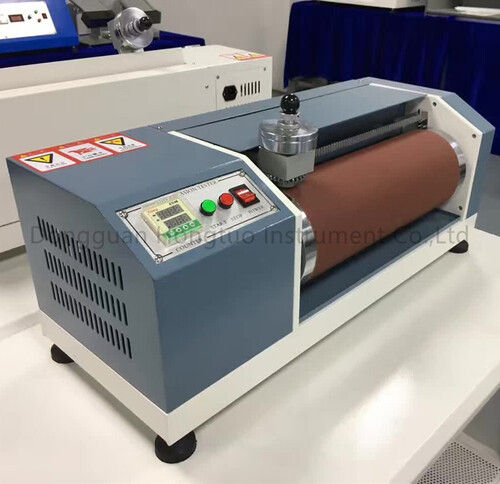
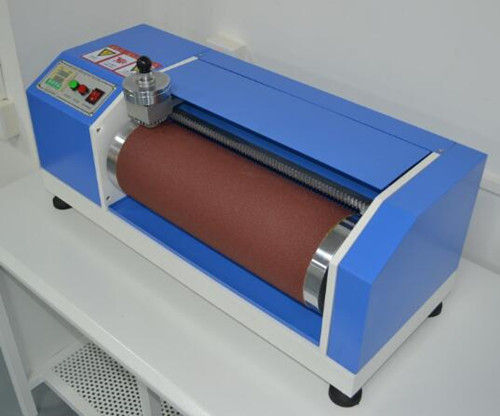
DIN Abrasion Testing Machine
Application
Suitable to determine the wear resistance of elastic material, rubber, tires,conveyor belts,shoe soles, soft synthetic leather and other materials.
Standards
DIN-53516,ISO/DIS-4649,GB-9867
Principle
Under a predetermined contact pressure and a given area,the specimen with sandpaper angled to measure abrasion resistance of the specimen subjected to rubbing on a certain level of sandpaper, sandpaper affixed to the surface of the drum, samples pressed on a drum with sandpaper, and the specimen along the roller to the lateral movement, abrasion resistance is produced at one end of the cylindrical specimen, tests the value of the mass loss of the specimen, by the density of the specimen to calculate the amount of volume abrasion.
Specifications
- Roller diameter:150mm
- Roller length:460mm
- Rotate speed:40rpm
- Abrasion stroke:40mm(20mm)
- Abrasion speed:0.32m/sec
- Dip angle:3 degree
- Specimen diameter:16 mm
- Thickness:6 -15 mm
- Testing load:5N,10N
- Clamp horizontal displacement:4.2mm/roll each lap
- Standard accessories:one set of sampler,two pieces of abrasive
Accurate Abrasion MeasurementEquipped with a digital LCD display and precision calibration, the DIN Abrasion Testing Machine delivers highly accurate results for wear resistance, measuring down to 0.01 mm. The test parameters, including load and cycle count, are adjustable to suit various specimen requirements.
User-Friendly and Safe OperationOffering both manual and digital control modes, the machine features an easy-to-use interface, secure specimen holder, protective shield, and an emergency power-off system. Safety and efficiency are core aspects, making it ideal for laboratory and industrial test settings.
Versatile Application and ComplianceSuitable for rubber, polyurethane, and similar materials, this machine complies with DIN, ISO, and ASTM standards. It supports semi-automatic operation, making it efficient for manufacturers, distributors, and traders seeking standardized abrasion resistance testing.
FAQs of DIN Abrasion Testing Machine:
Q: How does the DIN Abrasion Testing Machine assess abrasion resistance in materials?
A: It measures the amount of wear on rubber, polyurethane, and elastomer specimens by rotating the sample against a DIN-certified abrasive sheet on a drum, under a precisely controlled load, and recording material loss to an accuracy of 0.01 mm.
Q: What types of specimens can be tested with this machine?
A: The machine is suitable for specimens with diameters of 16 mm, thicknesses of 6 mm, and hardness levels between 35 and 85 Shore A, making it ideal for rubber, polyurethane, and other elastomers.
Q: When should calibration be performed on the DIN Abrasion Testing Machine?
A: Calibration is recommended before initial use, following significant maintenance, and at regular intervals as specified in laboratory protocols. The machine comes supplied with a calibration certificate for traceable accuracy.
Q: Where is the DIN Abrasion Testing Machine commonly used?
A: It is widely used in laboratories and industrial settings for manufacturers, distributors, and suppliers seeking compliance with DIN 53516, ISO 4649, and ASTM D5963 standards for abrasion resistance testing.
Q: What is the testing process with this machine?
A: Prepare the specimen, securely mount it in the holder, set the required load (510 N), parameters, and cycle count, and start the test. Measurement is automated with immediate digital readout for efficient, precise results.
Q: How does the safety system benefit the user during operation?
A: The machine includes a protective shield and emergency power-off function to prevent accidents and ensure safe handling, even during unexpected incidents. This guarantees a safer environment for laboratory or industrial use.
Q: What are the key benefits of using this DIN Abrasion Testing Machine?
A: Key advantages include high measurement accuracy, adjustable test settings, compliance with international standards, reliable calibration, easy operation, and enhanced safety, ensuring consistent, repeatable quality control for various elastomeric materials.
 English
 Spanish
 French
 German
 Italian
 Chinese (Simplified)
 Japanese
 Korean
 Arabic
 Portuguese










 Send Inquiry