Product Description
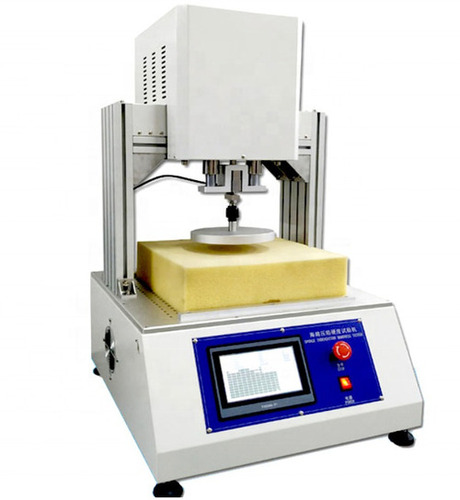
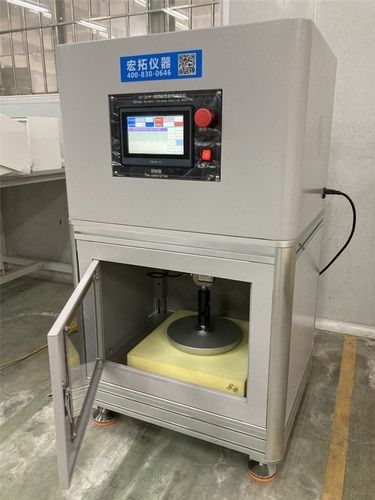
DH-IH Sponge Foam Indentation Hardness Testing Machine
Application:
This machine is used to measure the concave hardness of porous elastic materials. The polyurethane sponge foam sample can be tested according to the national standard, and the hardness of the sponge, foam and other materials can be accurately measured. It can also be used to measure the specified indentation hardness of the seat foam (such as the backrest, cushion foam, etc.) that has been produced, and accurately measure the indentation hardness of the foam accessories of the seat.
Principle:
Place the sample between the upper and lower platens, and the upper platen compresses the sample of a certain size downward at a predetermined speed to the concavity specified by the A method (B method, C method) required by the national standard. The load cell thereon feeds back the sensed pressure to the controller for processing and displaying, thereby measuring the indentation hardness of materials such as sponges, foams.,etc.
Function and Feature:
1. Automatic clearing: After the computer receives the test start command, the system will automatically do zero clearing.
2. Automatic return: After the sample is broken, it will automatically return to the initial position.
3. Automatic shifting: According to the size of the load, different gear positions can be switched to ensure measurement accuracy.
4. Change speed: This machine can change the test speed arbitrarily according to different samples.
5. Indication verification: The system can achieve accurate calibration of force values.
6. Control method: Test methods such as test force, test speed, displacement and strain can be selected according to the test requirements.
7.A multi-purpose machine: equipped with different specifications of the sensor, can achieve a multi-purpose machine.
8. Curve traversal: After the test is completed, the mouse can be used to find the point-by-point force value and deformation data of the test curve and analyze it.
9. Display: Dynamic display of data and curve test process.
10. Results: The test results are accessible and the data curve is analyzed.
11.Limit: with program control and mechanical limit.
12. Overload: Automatically stops when the load exceeds the rated value.
Technical Parameter:
- Sensing method: Force sensor automatic dispaly
- Load Cell Capacity:300Kg
- Motor: Servo motor control system
- Unit switch: Kg,N,Lb
- Testing stroke: 200mm
- Size of upper compressing plate: Diameter 200mm
- Bottom Border-radius: R1mm
- Lower platform: 420mm*420mm
- Air hole diameter: 6.0mm
- Hole center gap: 20mm
- Power: AC220V
Advanced Indentation Hardness TestingThe DH-IH Sponge Foam Indentation Hardness Testing Machine is designed for reliable and precise assessment of indentation hardness in laboratory and industrial environments. Following ASTM D3574, it offers digital measurement, efficient test cycles, and programmable controls to meet the demands of quality testing for soft material products like polyurethane foams and sponges.
User-Friendly and Automated OperationEquipped with microcomputer automatic control, digital LCD display, and intuitive PC software, the machine streamlines the testing process. Automatic data acquisition, simple report generation, and storage of up to 100 test records allow users to focus on analyzing results rather than manual record-keeping.
Robust Build and Safety FeaturesConstructed with a powder-coated steel frame in a blue and white finish, the machine is designed for durability and aesthetics. Safety is prioritized with emergency stop and overload protection, while low operating noise ensures suitability in various workspaces.
FAQ's of DH-IH Sponge Foam Indentation Hardness Testing Machine:
Q: How is the indentation hardness test performed with this machine?
A: The testing process involves placing a prepared specimen (typically 380 x 380 x 50 mm) on the machine, where the 50 mm indenter applies a controlled force. The microcomputer automates measurement of the resulting indentation, and readings are displayed digitally with high precision. The process can be quickly repeated for multiple samples, aided by programmable and automatic controls.
Q: What types of materials can the DH-IH Sponge Foam Indentation Hardness Testing Machine test?
A: This machine is designed primarily for indentation hardness testing of soft materials such as polyurethane foam and sponge. It adheres to the ASTM D3574 standard, making it suitable for laboratory or industrial quality assurance in applications dealing with similar soft materials.
Q: When and where should this testing machine be used?
A: The machine is ideal for both laboratory and industrial settings requiring consistent indentation hardness measurements. It is best utilized where quality assurance or R&D of soft materials is essential, and can operate in environments with temperatures between 10C and 40C and up to 80% RH (non-condensing humidity).
Q: What are the main benefits of using this hardness testing machine?
A: Users benefit from precise digital measurement (accuracy 0.5% F.S., resolution 0.1 N), automatic data collection, adjustable test speeds, and rapid cycle times. Enhanced safety features and low noise levels improve the user experience, while PC software simplifies data analysis and reporting.
Q: How are test results stored and managed?
A: The machine can store up to 100 test records in its internal memory. Test data can also be transferred via RS232 or USB interface to a PC, allowing further analysis and report printing using the provided software.
Q: What is the typical process from loading the specimen to result output?
A: First, the user mounts a specimen to the platform and configures the test parameters (speed, cycle time). With a push of a button, the machine lowers the indenter onto the sample, measures indentation force over an adjustable cycle (usually 30 seconds), and displays the result digitally. The data can then be stored or exported as needed.
Q: Which safety and protection features are included in this equipment?
A: The DH-IH testing machine offers emergency stop functionality, current overload protection, and includes over-load safety mechanisms to safeguard both operator and equipment during use.
 English
 Spanish
 French
 German
 Italian
 Chinese (Simplified)
 Japanese
 Korean
 Arabic
 Portuguese










 Send Inquiry