Product Description
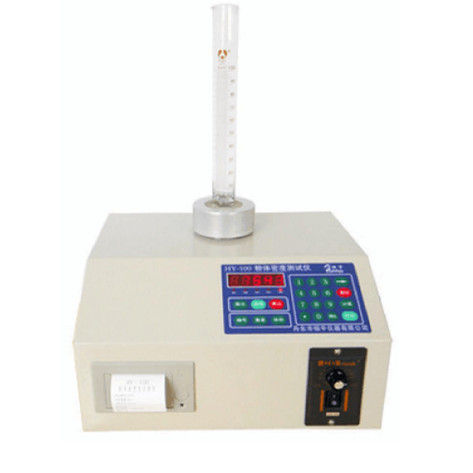
Tap Density Tester
Powder density is the mass per unit volume.it can be classified as bulk density and tap density by different measuring method.Tap density tester is to measure the density of powder has been tapped or packed by standardized and repeatable procedures according to international standards.
Introduction:
DY-100A,B,C Powder density tester is based on GB/T5162-2006/ISO3953:1993,ASTM B527.For non-metallic powder,This instrument extended several functions.such as"vibration amplitude" from 3m standard extended to 1mm-15mm;"vibration frequency"from 100-300 times per minute extended to
0-300 times per minute."vibration times"from 3000 times standard extended to 0-99999 times.All of them can be setup freely.
DY-100A,B,C Powder density tester consist of adjustable-speed motor,vibration
assembly,micro-computer and micro printer.,etc.It has the feature of compact
structure,stable,and easy operation.,etc.
Specification:
(1)Weight of testing object: less than or equal to 500.00g
(2)Volume of testing object:less than or equal to250.00ml(standard accessory including
25ml,50ml,100ml,250ml measuring cylinder)
(3)Single vibration times:less than or equal to0-99999 times(the result will come out as bulk density when input zero times)
(4)Allowable motor force:0.86 N.m.
(5)Vibration frequency:maximum 300 round per minute(0-300 round per minute is adjustable,USA pharmacopeia standard is 300 round per minute)
(6)Vibration amplitude:maximum 15mm(1mm-15mm is adjustable,International standard is 3mm)
Features:
1.Drop Height-Easily Adjustment
The drop height is important for a tap density tester in order to meet different international standards.This tap density tester uses default 3mm height and some tapping washers in specific height to reach 14mm.They changes easily without opening the cover.
2.Working Panel-Intuitive
The intuitive LED and membrane working panel brings operator and easy and fast operation.Accurate to 4 decimals.Automatically saving all test information.Operator simply inputs the desired data and press start to test.
3.Rpm-Easily Adjustment
The rpm is also important for a tap density tester.This instrument uses a speed control to realize 250rpm and 300 rpm.The motor is default 300 rpm,just tun the knob and reach the right percentage to shift to 250rpm.
4.Analysis Result-Easily Printed
Integrated micro printer prints the test data after test including Sample No,weight,volume,tap number,tap density and operator.
5.Cover-Easily to Clean
The outer surface is plastic coated,it is strong and resistant to any powders non-corrosive or corrosive.It makes for the cleaning procedure as well as a longer working life.
Advanced Digital Control with User-Friendly InterfaceExperience precision and convenience with digital timer controls, membrane keypad, and an easy-to-read LED display. Adjust tap cycles and counts with instant response and reliable repeatability, allowing both preset and continuous operation modes. The interface promotes intuitive operation for laboratory technicians.
Reliable and Safe Testing PerformanceThis Tap Density Tester guarantees safety with integrated overload protection and an emergency stop switch. With accurate tap height adjustment and a noise level below 65 dB at one meter, it ensures a secure, comfortable, and disturbance-free laboratory environment during operation.
Versatile Compatibility and Robust ConstructionConstructed from powder-coated mild steel with a corrosion-resistant finish, the tester fits standard ISO and USP glass cylinders (10250 ml), with manual height lock for the holders. The dual cylinder design and generous width accommodate a wide range of sample volumes for precise and efficient measurements.
FAQs of Tap Density Tester:
Q: How does the Tap Density Tester enhance laboratory powder measurement?
A: The Tap Density Tester automates tap density measurements through digital control, providing precise, repeatable results for powders and granules. With instantaneous response during tap cycles, dual cylinder capacity, and compliance with major international standards, it streamlines material analysis and quality assurance processes.
Q: What safety features are included in the Tap Density Tester?
A: Safety is ensured with built-in overload protection and an emergency stop switch. These features protect both the operator and equipment during operation, making it suitable for regular laboratory use in various testing environments.
Q: When should I use continuous versus preset tap cycles?
A: Continuous tap cycles are preferred for extended tests or when specific tap counts are not required, while preset cycles are ideal for standardized testing methods that specify a set number of taps. You can easily select the mode to match your testing protocol using the digital controls.
Q: Where can this Tap Density Tester be installed in a laboratory?
A: Designed as a benchtop unit with a compact footprint, the tester fits comfortably on most laboratory benches. Its smooth finish and corrosion-resistant body enable safe placement in a variety of ambient conditions between 10C and 40C and up to 90% relative humidity (non-condensing).
Q: What is the process for measuring tap density with this tester?
A: Load the appropriate glass cylinders (provided) with your sample and secure them using the adjustable holders. Preset the desired tap count or timer via the keypad, start the cycle, and observe real-time data on the digital LED display. After the test, the instrument provides accurate tap density readings for analysis.
Q: How does the tester accommodate different sample sizes and applications?
A: Compatibility ranges from 10 ml to 250 ml graduated cylinders, making it suitable for a wide sample spectrum. Manual height adjustment and dual holders support versatility, enabling tailored measurements for both research and commercial quality control needs.
Q: What are the main benefits of using this Tap Density Tester over manual methods?
A: Digitized operation, enhanced repeatability, high accuracy (1%), safety mechanisms, and instant response distinguish this tester from manual methods. Laboratories benefit from reduced operator intervention, standardized measurements, and improved reliability in their density testing programs.
 English
 Spanish
 French
 German
 Italian
 Chinese (Simplified)
 Japanese
 Korean
 Arabic
 Portuguese










 Send Inquiry