Product Description
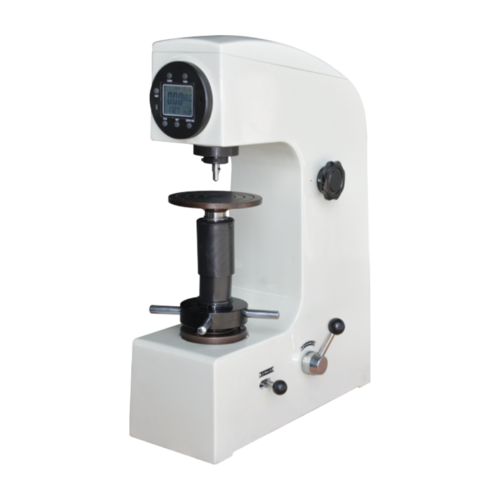
Digital Display Surface Rockwell Hardness Tester
Application scope:
Model HRS-150T is used to determine the Rockwell hardness of ferrous metals, non-ferrous metals, non-metallic materials, and is suitable for hardness testing of tempered, quenched and other heat-treated materials and hardness alloy materials.
Model HRS-45T is used to determine the surface Rockwell hardness of ferrous metals, alloy steels, hard alloys and metals after nitriding, cyanidation, carburizing, electroplating and other surface treatments.
Main Feature:
Digital display, direct reading of digital display, no artificial reading error, resolution up to 0.1HR, and can convert hardness value, mechanical manual testing process, no electrical control, precision oil pressure buffer, adjustable loading speed. Accuracy conforms to GB/T230.2, ISO6508-2 and American ASTM18 standards.
Main technical specifications:
Model: HRS-45T
Measuring range: 70-94HRN, 42-86HR30N, 20-77HR45N, 67-93HR15T, 29-82HR30T, 10-72HR45T
Maximum allowable height of the test piece: 170 mm
Distance from the center of the indenter to the machine wall: 135mm
Hardness resolution: 0.1HR
Dimensions: 466 x 238 x 630 mm
Weight about: 65kg
Effortless and Accurate Hardness MeasurementThis Digital Display Surface Rockwell Hardness Tester simplifies hardness testing with intuitive digital controls, automatic motorized loading, and a quick one-second response time. Its auto calibration and adjustable test forces (15, 30, 45 kgf) ensure consistent and reliable results on both flat and irregular specimens, with an accuracy of 1 HR.
Versatile Applications and Robust DesignBuilt with powder-coated cast iron, the tester withstands routine, rigorous use. Its compatibility with both diamond cone and steel ball indenters makes it suitable for a wide range of materials. The illuminated test area enhances visibility, while the benchtop mounting design saves workspace in labs and production environments.
FAQ's of Digital Display Surface Rockwell Hardness Tester:
Q: How does the Digital Display Surface Rockwell Hardness Tester ensure accurate measurements?
A: The tester uses automatic motorized loading and unloading, precise force application (15kgf, 30kgf, 45kgf), and complies with ISO 6508 and ASTM E18 standards to guarantee high-accuracy results within 1 HR. Its auto calibration feature further enhances measurement reliability.
Q: What is the process for conducting a hardness test with this equipment?
A: Place the specimen (up to 170 mm height and 0.08 mm thickness) on the platform, select the indenter and test force, and use the digital controls to start the automatic loading. The measurement is displayed on the digital LCD within one second. Data can be output via RS232 for analysis or record-keeping.
Q: Where can this hardness tester be used effectively?
A: It is ideal for use in research laboratories, quality control departments, production lines, and workshops requiring precise hardness evaluation of metals, alloys, and small parts. Its compact, benchtop design suits various environments and space constraints.
Q: What types of materials and part shapes can be tested with this device?
A: The tester is designed for measuring the surface hardness of flat, cylindrical, or small parts using Rockwell HRN and HRT scales. Its dual indenter system (diamond cone and steel ball) allows testing on a wide array of metals, hardness ranges, and surface geometries.
Q: How does the inbuilt backup battery benefit the user?
A: The integrated battery retains memory, preserving data and calibration settings in the event of a power disruption. This feature ensures continuous, reliable operation and safeguards measurement records.
Q: When should I calibrate the hardness tester?
A: Calibration should be performed when the instrument is first installed, after extended periods of use, following major maintenance, or if measurements appear inconsistent. The tester's auto calibration capability simplifies this process.
Q: What are the key benefits of using a digital display in this hardness tester?
A: The digital LCD provides clear, immediate readings, allows for rapid data interpretation, and reduces operator error. Its resolution of 0.1 HR and one-second response time support more efficient and accurate testing workflows.
 English
 Spanish
 French
 German
 Italian
 Chinese (Simplified)
 Japanese
 Korean
 Arabic
 Portuguese











 Send Inquiry