Product Description
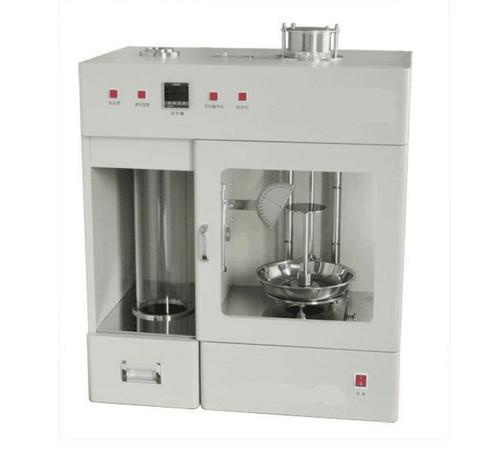
Scott Volumeter Bulk Density Meter
Principle:
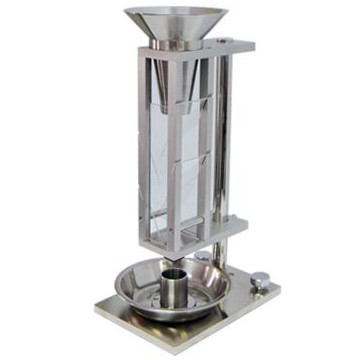
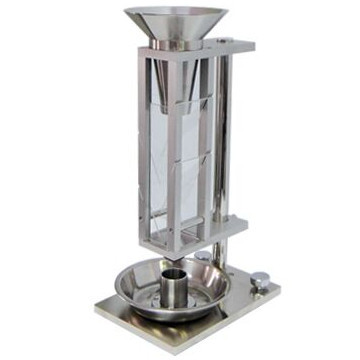
Place the powder into the upper mesh sieve, flow into the clothing box by the nature or outside force, powder flow into four pcs glass baffles and square funnel with angle 25 degree, at last flow into sample receiving cup, it is in the bulk type. Customer can weigh the powder weight in the cylindrical receiving cup;
Scott Volumeter (Bulk Density Tester) is designed and produced according to GB5060-85 "Metal Powder Density Testing Second part: Scott Volumeter", it is also in accordance with International standard ISO 3932/2"Metal Powder Bulk Testing Second part: Scott Volumeter",It is suitable for powder can not flow into funnel freely with opening size at 5mm or the powder characteristic will be charged during vibrating funnel;
Feature:
1. Stainless Steel top funnel: it is composed by two pcs Stainless Steel Conical funnel, separate by the cylinder, inside with the opening size 1.18mm Stainless Steel sieve;
2. Clothing box: cross section is square shape, there are 4 pcs 1 mm thick Stainless steel board slide on the Aluminium frame inside; Inside and outside frame, there is Plexiglas plate, Stainless steel board can take off, it is easy to clean and wash
3. Square shape funnel: it is welded by 1mm Stainless Steel board, angle is 60 degree square conical shape, upper dia. is 12.5mmx12.5mm;
4. Cylindrical receiving cup: volume is 25ml, Stainless stee
5. Steel frame: it holds upper assembly funnel, clothing box, square funnel, cylindrical receiving cup;
6. Balance: it weights powder sample, maximum capacity is 1kg,accuracy is 0.02g (optional parts)
Precise Bulk Density MeasurementEngineered for the accurate determination of bulk density in powders, the Scott Volumeter Bulk Density Meter offers reliable results within a typical range of 0.15 to 2.0 g/cm. Its four-tube design ensures repeatable sample distribution, while the transparent graduated chambers allow for easy observation and recording of measurements.
User-Friendly and Manual OperationWith a mechanical/manual operation mode, this meter is simple to use, requiring no external power supply. The immediate response time and manual reading feature make it suitable for various environments, including laboratories and educational settings. Cleaning is effortless due to its easily disassembled design.
Compliant and Durable ConstructionMeeting strict ASTM B329, USP, and ISO 3923-2 standards, the meter is constructed from corrosion-resistant stainless steel and acrylic. The all-metal build and export-quality packaging guarantee longevity and safe transportation, making it ideal for global distribution and routine laboratory use.
FAQs of Scott Volumeter Bulk Density Meter:
Q: How does the Scott Volumeter Bulk Density Meter measure powder density?
A: The meter determines bulk density by passing powdered samples through four standardized flow-tubes into a transparent graduated chamber, where the resulting volume is measured manually to calculate density.
Q: What types of powders can be tested with this equipment?
A: It is designed to measure the bulk density of free-flowing powders, making it suitable for a wide range of laboratory and industrial powder materials.
Q: When should I use this bulk density meter in my testing process?
A: Use the Scott Volumeter during laboratory quality control or research when precise bulk density measurements of powders are required, following compliance with ASTM, USP, or ISO standards.
Q: Where is the Scott Volumeter best utilized?
A: The device is ideally suited for laboratory benchtops in quality control labs, research institutes, and educational environments where powder characterization is necessary.
Q: What is the process for cleaning and maintaining the meter?
A: The Scott Volumeter is easy to disassemble, allowing thorough cleaning of stainless steel and acrylic chambers between tests, which prevents cross-contamination and ensures consistent results.
Q: What are the advantages of using a manual bulk density meter?
A: Manual operation allows immediate results without the need for a power supply, ensures high measurement accuracy, and makes the instrument highly reliable for routine laboratory tasks.
Q: How much powder sample is required for each test?
A: For each test, it is recommended to use a sample volume of 1070 cc, with the receiving cup accommodating up to 100 cc to ensure precise and repeatable measurements.
 English
 Spanish
 French
 German
 Italian
 Chinese (Simplified)
 Japanese
 Korean
 Arabic
 Portuguese









 Send Inquiry