Product Description
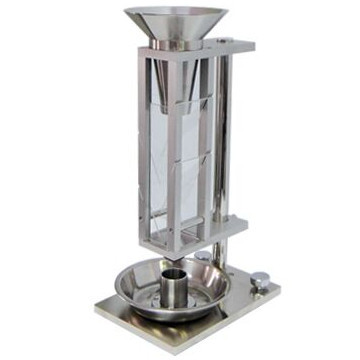
Hall Flowability and Bulk Density Tester
In accordance with ASTM B213-13,JISZ 2502,ISO4490,ISO 3923,GB/T1482,GB/T1479,
hall flowability tester has been widely applied to determine flowability and bulk density for metal powder or other powder.Any powder can pass through funnel with 2.5mm standard diameter aperture.it can be tested by using this machine.
Principle:
The flowability:
The flowability of metal powder can be indicated as the time needs when 50g metal powder pass through standard funnel with specified aperture.
The bulk density:
The powder is freely flowed from a fixed height funnel into a measuring cup of known volume to obtain a powder in a loose state; the mass of the powder is weighed, divided by the volume of the measuring cup,the bulk density =m / v, the unit is g/cm3.
Structure:
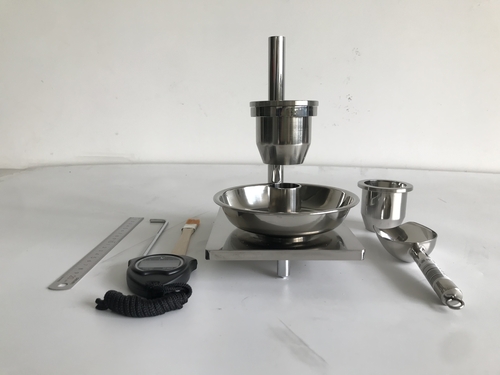
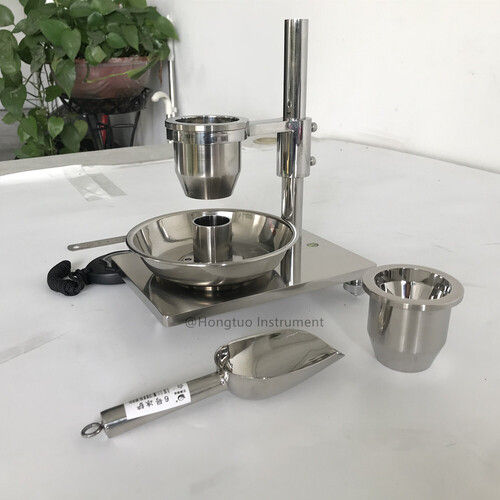
(1)Funnel(diameter of aperture 2.5mm,5mm)
The funnel is made up of stainless steel.the inner surface has been polished specially.which makes it very smoothly.Besides,sufficient thickness and hardness can avoid from transformation and excessive wear.
2.5mm aperture for measuring flowability,5.0mm aperture for measuring bulk density.
(2)Holder,base and receiver
Holder is used to fix funnel.Base is used to install holder and receiver.
(3)Digital scale:maximum weight is 1kg.weight resolution is 0.02g.
(4)Chronograph:0.1s
(5)Measuring cup
31mm 25ml stainless steel measuring cup.
Versatility for Diverse PowdersThis tester is engineered to accurately determine the flow rate and bulk density of both metallic and non-metallic powders. Its standard 2.50 mm Hall funnel orifice and adjustable accessories accommodate a variety of powder types, providing reliable data essential for industrial and laboratory settings.
Precision and Safety IncludedEquipped with a mirror-polished stainless steel funnel and a borosilicate glass or polycarbonate receiver cylinder, this tester delivers consistent results. The instrument includes a calibration certificate, giving users confidence in its measurements and compliance with industry standards.
Effortless Maintenance and OperationAll parts are detachable and washable, ensuring quick and effective cleaning between tests. The user-friendly, manual operation, paired with gravity flow, enables controlled and straightforward measurement. Its stable, tabletop design and included accessories make it perfectly suited for regular lab use.
FAQs of Hall Flowability and Bulk Density Tester:
Q: How is the Hall Flowability and Bulk Density Tester used to measure powder flow rate and bulk density?
A: The tester is used by loading a single 50 g sample of powder into the stainless steel funnel. As powder flows by gravity through the orifice, a supplied analog stopwatch measures the flow time to an accuracy of 1 second. The bulk density is determined by the amount collected in the receiving cylinder. This process is ideal for quality control in powder metallurgy laboratories.
Q: What types of powders can be tested with this device?
A: This instrument can measure both metallic and non-metallic powders. Its standard orifice and robust construction make it suitable for a wide variety of granular materials commonly encountered in research, metallurgical, and quality assurance environments.
Q: When should the device be cleaned, and how is maintenance performed?
A: Cleaning is recommended after each test or when changing powder types to prevent cross-contamination. The funnel and cylinder are detachable and washable, allowing for thorough and easy maintenance. Use mild detergents with water and dry before reassembly.
Q: Where is the best location to use this Hall Flowmeter Funnel?
A: For optimal results, operate the device indoors, positioned on a stable tabletop within laboratory environments where temperature ranges from 15C to 35C and relative humidity is maintained between 40% and 75%.
Q: What are the benefits of using the supplied accessories with this tester?
A: Included accessories such as the analog stopwatch, powder spatula, and calibration certificate enhance usability, ensure accurate timekeeping, facilitate sample handling, and confirm measurement traceability, streamlining the testing workflow.
Q: How does manual control affect the precision of powder measurements?
A: Manual control, coupled with gravity flow, provides immediate response and direct oversight, ensuring that any variabilities are minimized and allowing users to precisely monitor and record flow times up to a resolution of 0.1 second.
 English
 Spanish
 French
 German
 Italian
 Chinese (Simplified)
 Japanese
 Korean
 Arabic
 Portuguese









 Send Inquiry