Product Description
Application
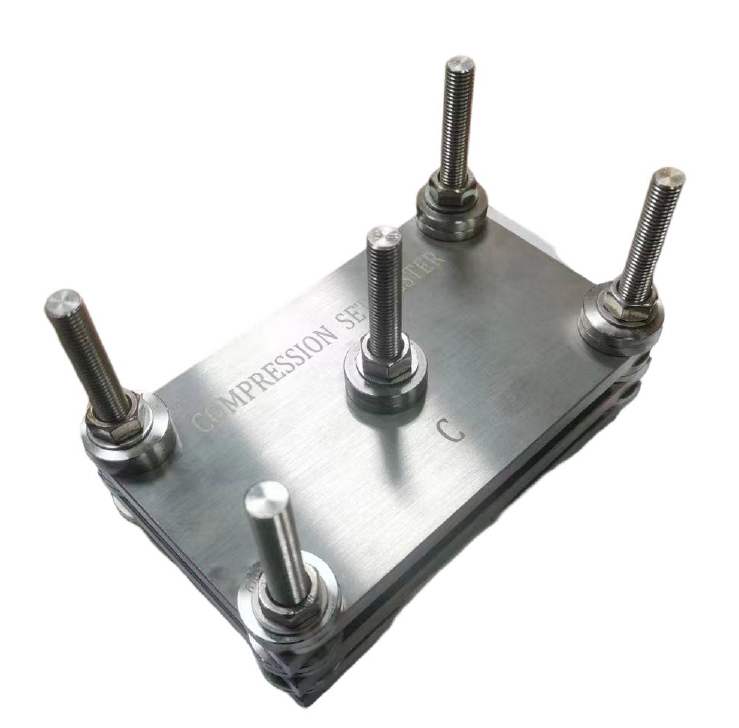
The rubber compression set tester compresses a sample of known height to a specified height according to the compression rate requirement, maintains it for a certain time under specified temperature conditions, then releases the compression, restores the sample to a free state, and measures the height of the sample.
The compression set tester consists of parallel steel plates, limiters and fasteners. It is used to measure the deformation of vulcanized rubber, thermoplastic rubber or foam at room temperature, high temperature and low temperature conditions, at a certain compression rate and after a certain compression time.
Standards
ASTM D395 - 03 Standard Test Methods for Rubber PropertyCompression Set
ISO 815-1 Determination of compression set of vulcanized rubber or thermoplastic rubber Part 1: At room temperature and elevated temperature
GB/T 7759.1 Determination of compression set of vulcanized rubber or thermoplastic rubber Part 1: At room temperature and elevated temperature
Technical Parameters:
1. Limiter height:
(1) Type A specimen diameter 29mm, height 12.5mm
9.39.4 when compression rate 25%
10.610.7 when compression rate 15%
11.2511.35 when compression rate 10%
(2) Type B specimen diameter 13mm, height 6.3mm
4.74.8 when compression rate 25%
5.35.4 when compression rate 15%
5.655.7 when compression rate 10%
2. Dimensions of rubber permanent compression deformation tester: width 120mm, length 200mm
3. Weight: about 15Kg
Principle:
A sample of known height is compressed to a specified height according to the compression rate requirements, maintained at a specified temperature for a certain period of time, and then the compression is released, the sample is restored to a free state, and the height of the sample is measured.
Testing procedure:
1. The sample should be treated at (232), (505)%RH for 24h.
2. Measure the original thickness of the sample, accurate to 0.02mm.
3. Put the sample into the instrument, place the pad corresponding to the sample type, and lock the instrument. It can be carried out at room temperature.
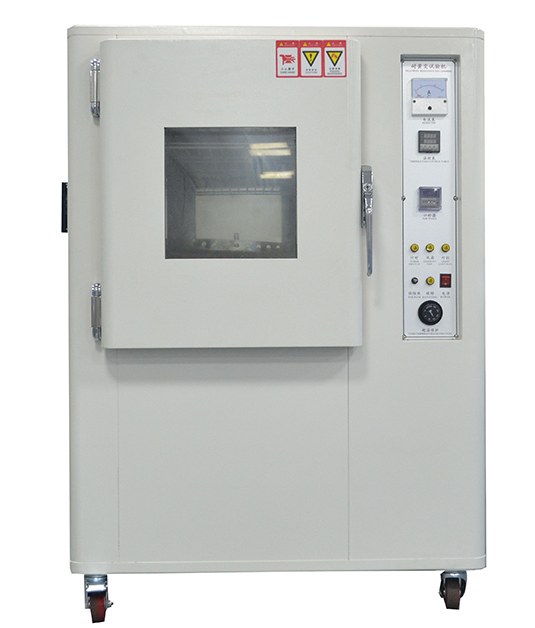
4. After clamping the sample, it must be placed in an oven with set temperature within 2h.
The test temperature and time refer to the standard or are specified by the customer. For example, ASTM D1349-99 has: -75, -55, -40, -25, -10, 0, 23, 40, 55, 70, 85, 100, 125, 135, 150, 160, 175, 200, 225, 250.
The recommended test time for the rubber compression deformation tester is 22h and 70h (SGSin house method).
5. After the test time is over, immediately remove the instrument from the oven and remove the sample.
Place the sample on a poor thermal conductor such as a wooden board and cool it at (232), (505)%RH.
6. After cooling for 30 minutes, measure the thickness of the sample again.
Results Calculation:
C = [(To-Ti)/(To-Tn)] 100%
CCompression deformation, %
TnThickness of pad, mm
ToThickness of specimen before test, mm
TiThickness of specimen after test, mm
Precision Material Testing for ElastomersThis compression set tester ensures reliable determination of permanent deformation in rubber materials, crucial for quality control in production and research labs. With a robust stainless-steel body and polished surface, it delivers consistent results while enduring rigorous laboratory environments. Compatibility with ASTM D395 and ISO 815 standards guarantees industry compliance.
Engineered for Versatility and Ease of UseThe tester features customizable spacers, allowing users to perform varied compression levels, and supports the testing of standard and custom specimen sizes. Its manual threaded rod system provides intuitive control without the need for external power, making it suitable for a wide range of laboratory setups.
FAQ's of Rubber Compression Set Tester for Elastomer Testing:
Q: How is the Rubber Compression Set Tester used during elastomer testing?
A: To use the tester, specimens of standardized size are placed between the polished stainless-steel plates, with spacers setting the desired compression. Bolted firmly using threaded rods, the assembly is then placed in a temperature oven, typically up to 200C, for a specified period as outlined by ASTM D395 or ISO 815. After cooling, measurements of thickness changes determine the material's compression set.
Q: What benefits does the high-grade stainless steel construction provide?
A: High-grade stainless steel ensures superior durability, resistance to corrosion from repeated oven cycles, and a polished surface that reduces sticking and facilitates easy cleaning. This longevity and low maintenance enable reliable use in demanding laboratory conditions.
Q: When should periodic maintenance or cleaning be performed on the tester?
A: Regular maintenance is minimal; the tester only requires periodic cleaning, especially after extensive use or contact with sticky elastomers. Cleaning helps maintain the polished surface and accuracy of test results.
Q: Where can this tester be used effectively?
A: The device is ideal for laboratory environments that require elastomer or rubber compression set testing in accordance with ASTM D395 or ISO 815. Its benchtop, free-standing design makes it well-suited for research, manufacturing quality control, and academic laboratories.
Q: What is the typical testing process for a rubber specimen?
A: The specimen is compressed by mounting it between the plates with spacers, then exposed to elevated temperatures in an oven for a set duration. Initial and final specimen heights are measured to determine the permanent deformation, as specified by relevant standards.
Q: How many samples can be tested simultaneously, and what specimen sizes are supported?
A: Typically, up to three specimens can be tested at once, following standard sizes such as 13 mm diameter by 6 mm thickness (ASTM D395), though custom sizes can be accommodated based on the selected spacers and plate dimensions.
Q: What are the main benefits of manual operation without a power supply?
A: Manual control eliminates the need for electrical connections or motors, minimizing equipment complexity and maintenance. This also allows for immediate response and adjustments during testing, enhancing operator involvement and versatility in the laboratory.
 English
 Spanish
 French
 German
 Italian
 Chinese (Simplified)
 Japanese
 Korean
 Arabic
 Portuguese










 Send Inquiry
