Product Description
Standards:
AS/NZS20882000 ASTM-F833 and CNS 6263-11BSL-1996EN18882003
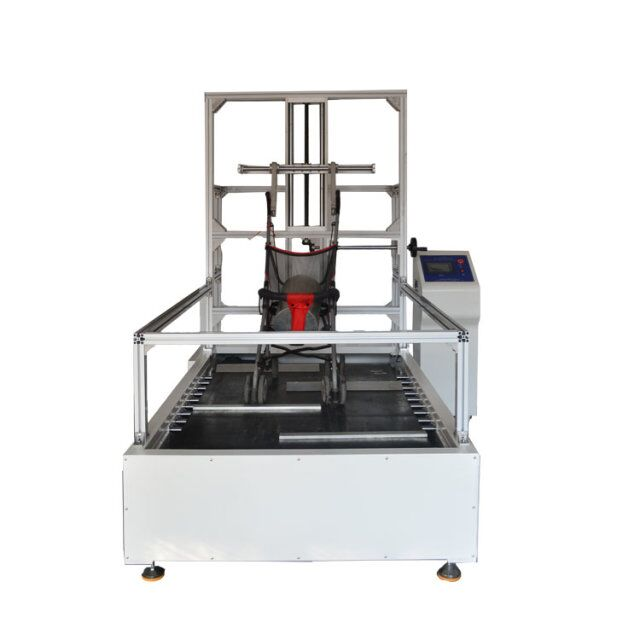
The test method: place the model baby in the carriage, fix the carriage on the test bench, and adjust the conveyor belt speed to about 1.40.1km/h. After 64 hours of continuous testing, visually check whether the carriage is damaged. The operation will automatically stop when the set number of times is reached. The machine is equipped with an electric eye safety device to prevent the baby carriage from losing control and damaging the test machine due to the breakage of the handle and rubber ring. This machine is suitable for dynamic durability testing of the bottom wheels and body of a hand-pushing baby carriage when it is moving in simulated road conditions.
1. Test work: Single-seat vehicle body
2. Test speed: 5km/h0.1km/h (adjustable)
3. Drive mode: Roller-driven canvas rubber conveyor belt and reinforced with rollers to drive special aluminum alloy conveyor belt
4. Drive horsepower: AC380V*3HP
6. Effective width: Max1000mm
7. Test count: 0-99999999
8. Load: MAX50 pounds
9. Machine power supply: AC380V
10. Impact block shape: trapezoidal, semi-arc or specified
11. Overall dimensions: 230x120x200cm
Reliable Durability Testing SolutionThe HT-SD Dynamic Durability Testing Machine allows manufacturers, suppliers, and labs to assess baby stroller performance under repeated dynamic conditions. Its strong aluminum-steel frame and adjustable parameters ensure adaptability for various stroller sizes and compliance needs.
Advanced Safety and Automation FeaturesWith a touch screen PLC control panel, automatic cycle programming, and a secure safety door that halts operations when opened, the machine maximizes both operator safety and test accuracy. Real-time data recording further enhances process traceability.
Easy Data Export and Compliance AssuranceAll test results are automatically recorded and can be easily exported for reporting or certification. The machine supports major international testing standards, including EN1888, ASTM F833, and ISO 7176, with customizable options for specific requirements.
FAQ's of HT-SD Baby Stroller Dynamic Durability Testing Machine:
Q: How does the HT-SD Baby Stroller Durability Testing Machine ensure operator safety during operation?
A: The machine is equipped with a safety door that automatically stops the test when opened, and comes with upper and lower travel limit sensors to prevent run-off, providing multiple layers of protection for operators.
Q: What types of strollers can be tested with this machine?
A: The HT-SD tester accommodates most stroller sizes due to its universal specimen fixtures and adjustable test width, making it suitable for various designs and models up to 70 kg in capacity.
Q: When should I use the dynamic durability testing machine in the stroller production process?
A: This machine is best used during laboratory quality inspection, prior to product certification and market release, to verify the long-term durability and safety performance of strollers.
Q: Where should I install the HT-SD testing machine for optimal operation?
A: The equipment should be placed indoors in a clean, vibration-free environment maintained between 10C to 40C and 20% - 80% relative humidity to ensure reliable and accurate testing.
Q: What is the process for conducting a stroller durability test using this machine?
A: Simply mount the stroller specimen, program your desired test cycle and parameters via the touch screen, and initiate the test. The machine will automatically execute the programmed number of cycles, record data, and stop if any safety thresholds are breached.
Q: How does automatic data recording benefit my testing workflow?
A: Automatic recording and export of test data ensure accurate documentation, efficient traceability, and easy preparation of certification or performance reports, reducing manual tracking errors.
Q: What are the main advantages of using this dynamic testing machine for stroller manufacturers?
A: Manufacturers benefit from programmable and precise testing, robust safety mechanisms, compliance with international standards, and streamlined certification processes, all contributing to higher product reliability and marketability.
 English
 Spanish
 French
 German
 Italian
 Chinese (Simplified)
 Japanese
 Korean
 Arabic
 Portuguese










 Send Inquiry
