Welcome to Our Company
 English
 Spanish
 French
 German
 Italian
 Chinese (Simplified)
 Japanese
 Korean
 Arabic
 Portuguese

Call Us+8613267004347


Introduction:
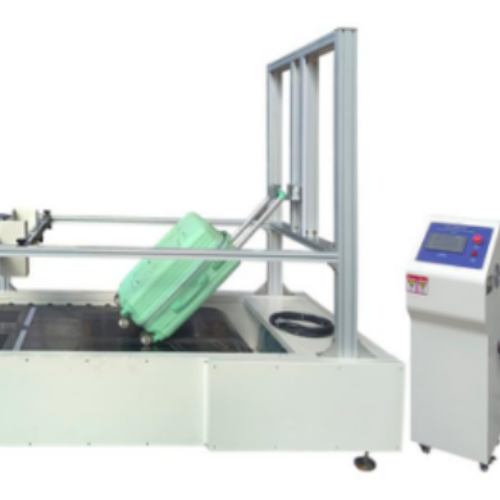
The suitcase walking bump test machine is a professional device used to test the performance of wheeled suitcases, travel bags, and other luggage products during walking. By simulating the bumpy conditions of actual walking, it comprehensively evaluates the quality of the suitcase wheels. It can accurately detect the heat resistance, breakage, and wear of the wheels under different speed and mileage conditions, and effectively inspect the wear resistance of the wheel materials and whether there is any damage or deformation to the overall structure of the suitcase. The test results are of great reference value for luggage manufacturers to improve product design and enhance product quality.
Features:
1. High Simulation Capability It accurately simulates various bumps and vibrations encountered by a suitcase during actual use. Through a specially designed bumper, abrasive cloth, and conveyor belt, it generates impact, vibration, and wear on the suitcase, highly replicating real-world usage scenarios. This ensures reliable test results and provides strong evidence for evaluating suitcase quality.
2. Comprehensive Testing Functions In addition to testing the heat resistance, cracking, wear, and abrasion resistance of the wheels, it comprehensively tests the wheel axles, wheel frames, pull rods, and the overall structure of the suitcase, checking for damage, deformation, and other issues. It covers multiple key areas where problems may occur in real-world use, enabling multi-functional testing.
3. Flexible Parameter Settings The test speed is continuously adjustable from 0 to 5 km/hr, allowing for flexible setting of test speed and time according to different testing needs. Furthermore, the equipped suitcase fixing adjustment seat can be flexibly adjusted to accommodate different sizes and shapes of suitcases, ensuring that suitcases of various specifications are securely fixed during testing and guaranteeing accuracy.
4. Wide range of applications Not only suitable for testing suitcases of various sizes and materials, but also for testing other wheeled bags such as travel bags and strollers. It is suitable for manufacturers to conduct performance testing on new products during the product development stage to improve design; to control product quality during production to ensure compliance with standards; and also suitable for quality inspection agencies and research institutions in related fields for research and testing work.
Test Standards:
QB/T 2920-2013 "Luggage - Test Methods for Walking"
ISO 8516:2009 "Luggage - Travel Bags - Test Methods for Durability"
ASTM D4169 "Standard for Testing the Performance of Transport Packaging"
ISO 4893 "Test Methods for Luggage and Bags"
Technical Parameters:
|
Test speed |
0 - 5km/hr |
|
Time-kilometer setting |
The general rule is to rest for 10 minutes every 2 kilometers. Different distances and rest periods can be set according to different requirements. |
|
Bumper board specifications |
300303mm,8 Pcs |
|
Sandpaper specifications |
3#200200mm |
|
Conveyor belt size |
33007508mm |
|
Suitcase fixing adjustment seat |
It can accommodate suitcases of different sizes and shapes, with an adjustment range of 300-800mm in length, 200-600mm in width, and 100-500mm in height. Through flexible adjustment, it ensures that the suitcase is firmly fixed during the test, preventing the test results from being affected by shaking or displacement. |
|
Volume |
1950x100x1400mm |
|
Power supply |
AC220V50Hz |
Machine Structure Design:
|
Structural method |
Remark |
|
Main frame structure |
The main frame is welded from high-strength steel and is rectangular in shape, providing stable support. The steel is hot-dip galvanized or coated with anti-corrosion paint to prevent rust and adapt to complex environments. Internal reinforcing ribs enhance rigidity, ensuring the frame does not deform during operation and guaranteeing testing accuracy and equipment safety. |
|
Power source |
Using a variable frequency motor or servo motor, continuous speed regulation from 0 to 5 km/hr can be achieved. By adjusting the parameters of the frequency converter, the running speed of the conveyor belt can be precisely controlled to simulate the actual situation of the suitcase at different walking speeds. |
|
Transmission components |
Utilizing belt drive, the conveyor belt is made of high-quality, wear-resistant, and tensile-resistant rubber or polyurethane material, capable of withstanding the weight and friction during suitcase testing. The drive roller connects to the motor output shaft, responsible for power transmission, while the driven roller supports and adjusts the tension to ensure the conveyor belt does not slip or deviate. A tensioning device is also provided, allowing for tension adjustment as needed to ensure stable and reliable transmission. |
|
Bumper board |
Typically made of high-strength metal or engineering plastic, the surface is specially treated to create specific unevenness to produce a bumpy effect. Eight bumper plates are evenly distributed under the conveyor belt. As the suitcase moves along the conveyor belt, it is subjected to impact and vibration, simulating real bumpy road conditions. Their thickness, shape, spacing, and other parameters are carefully designed and optimized to effectively simulate complex road conditions and ensure the authenticity and validity of the test results. |
|
Fixed base |
Used to stabilize and secure cases, it employs adjustable clamps or brackets that can be flexibly adjusted according to the size and shape of the case. The case is firmly fixed to the conveyor belt with bolts and nuts, preventing shaking or displacement during testing and ensuring accurate results. |
|
Operation panel |
Featuring a human-machine interface design and equipped with a touchscreen operating interface, it facilitates parameter setting and operation control. The panel has buttons for speed adjustment, time setting, start/stop, etc., allowing operators to easily set test speed, time, and other parameters, and monitor the equipment's operating status in real time. |
|
Safety protection |
Equipped with an infrared sensor, the machine automatically stops operating when another object enters the conveyor belt. |
Software Function Setting:
1. Speed Setting: The conveyor belt speed can be precisely set according to different testing standards and actual needs, simulating the bumpy ride of a suitcase at different walking speeds. The speed range is generally continuously adjustable between 0-5 km/hr.
2. Distance Setting: The test distance can be flexibly set to meet the distance requirements of different suitcase tests, comprehensively evaluating the suitcase's performance under long-distance bumpy conditions.
3. Interval Time (in kilometers) Setting: The test interval (in kilometers) and time can be set to meet the walking distance and rest time requirements of different suitcases.
Testing Procedure:
1. Preparation: Select a suitcase walking vibration testing machine with matching specifications and performance based on the suitcase's size, weight, and testing requirements.
2. Equipment Inspection: Inspect all components of the testing machine for proper functioning, including whether the conveyor belt is damaged, whether the vibration device is working properly, and whether the sensors are sensitive. Ensure the equipment is clean and free of debris that could interfere with the test.
3. Suitcase Preparation: Clean and inspect the suitcase to be tested, recording its brand, model, size, and material. If the suitcase has adjustable parts such as handles or wheels, adjust them to their normal operating position.
4. Suitcase Securing: Place the suitcase on the testing machine's conveyor belt and secure it firmly using the dedicated securing device to ensure the suitcase will not move or shake during the test.
5. Parameter Setting: According to relevant standards or customer requirements, set the test parameters through the testing machine's software or control panel, including conveyor belt speed, test distance, and test interval in kilometers.
6. Start the Test: After confirming that the settings are correct, start the testing machine. The equipment will begin simulating the bumps and jolts experienced by the suitcase during travel. During the test, the operator should closely monitor the equipment's operating status and the condition of the suitcase. If any abnormality is detected, the machine should be stopped immediately for inspection.
7. Post-Test Processing: Conduct a comprehensive inspection of the suitcase after the test. Check for any external damage, such as scratches, cracks, or breaks. Inspect the handles, wheels, zippers, and other components for proper functioning, looseness, deformation, or damage. Also, check the internal structure for damage, such as deformation of the support structure.
8. Data Analysis and Report Generation: Analyze the recorded test data to evaluate the suitcase's performance in the bump and jolt test. Then, generate a test report according to the prescribed format. The report typically includes the test objective, test equipment, test parameters, suitcase information, test results, and conclusions.

Price:







 Send Inquiry
