Product Description
Introduction:
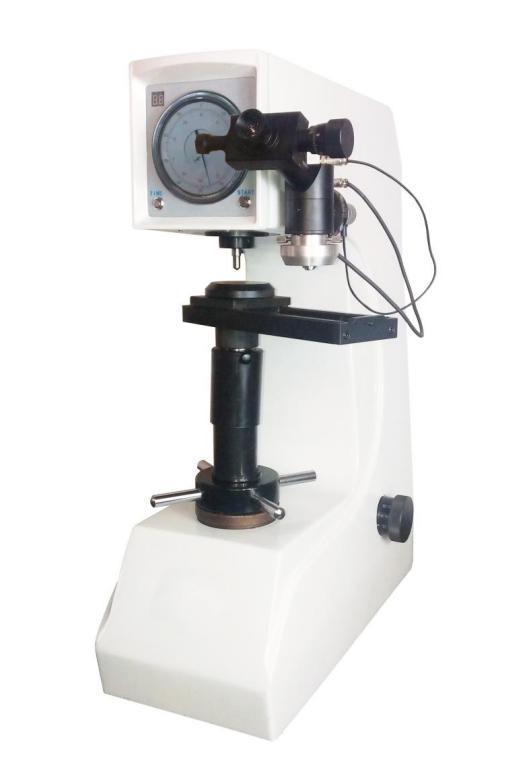
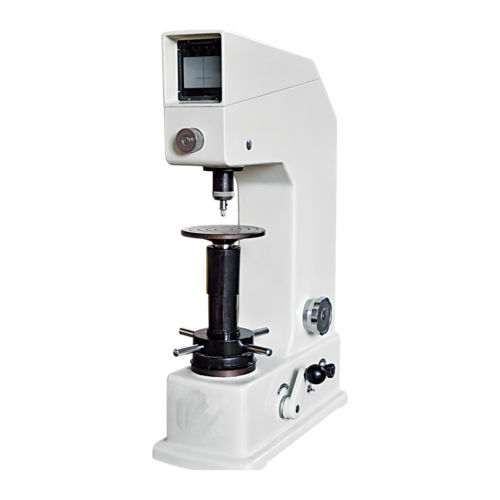
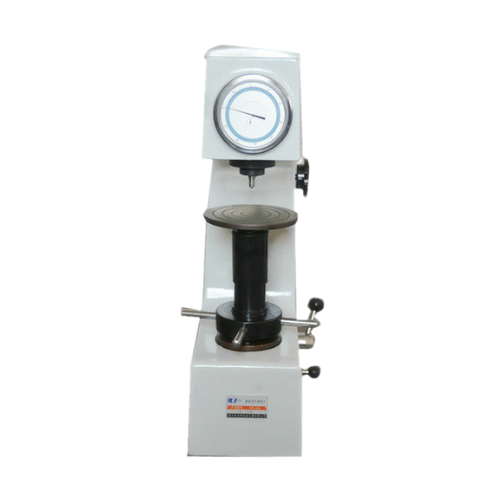
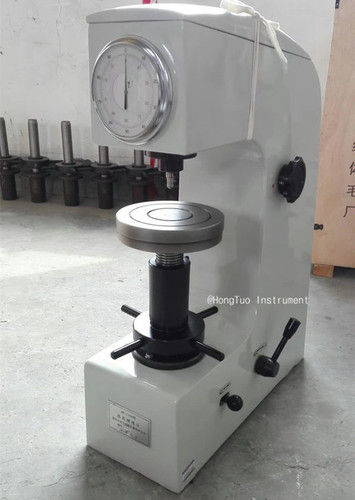
HBRVD-187.5 electric brinell rockwell vickers hardness tester has novel appearance, complete functions, convenient operation, clear and intuitive display, and stable performance. It can perform three hardness tests of Brinell, Rockwell and Vickers. It has the characteristics of high test accuracy, simple operation, high sensitivity, convenient use and stable indication.
Features:
1. The body part of the product is formed at one time by the casting process, and has undergone a long-term aging treatment. Compared with the paneling process, the long-term use of the deformation is small, and it can adapt to various harsh environments;
2. Car baking paint, high-grade paint quality, strong scratch resistance, and still bright as new after many years of use;
3. It has three test methods of Brinell, Rockwell and Vickers, and seven test force, which can meet various hardness test requirements;
4. The Rockwell hardness dial can be read directly, and the Brinell and Vickers hardness are measured by the high-definition optical system;
5. The motor controls the loading, unloading and holding process of the test force, which can better reduce the human operation error;
6. Lever force, frictionless spindle, high test force accuracy;
Scope of application:
1. Determination of Brinell, Vickers and Rockwell hardness of ferrous metals, non-ferrous metals and hard alloys;
2. Brinell hardness of castings, annealed steel, normalized steel, non-ferrous metals and soft alloys;
3. Rockwell hardness of heat treatment materials such as quenching and tempering;
4. Vickers hardness of nitriding layer, ceramics, thin plate, metal sheet, electroplating layer and tiny parts.
Versatile Hardness Testing Across Three MethodsThe HBRV-187.5 tester seamlessly switches between Brinell, Rockwell, and Vickers measurements, allowing one device to cover a broad range of hardness testing requirements. This flexibility streamlines your workflow and reduces the need for multiple machines in both laboratory and industrial settings, ensuring consistent and accurate results every time.
Precision Engineering for Reliable ResultsEngineered with a robust cast iron body, the HBRV-187.5 features precise manual controls, a 10x magnification optical system, and accurate test loads from 1 to 187.5 kgf. The tester meets ISO 6506, 6507, 6508, and ASTM E10/E18/E384 standards, ensuring results with 1% accuracy and 0.1 HR resolution for all major hardness scales.
Simple Operation and Convenient Specimen HandlingWith both flat and V-shaped anvils included, the tester supports various specimen shapes. The user-friendly analog dial display and mechanical controls make operation straightforward, while the spacious benchtop design accommodates workpieces up to 170mm in height and 150mm in width.
FAQ's of HBRV-187.5 Brinell Rockwell Vickers Hardness Tester:
Q: How does the HBRV-187.5 tester perform hardness measurements on different metals?
A: The HBRV-187.5 uses interchangeable diamond cone and hardened steel ball indenters, enabling it to apply Brinell, Rockwell, or Vickers test methods. This allows accurate hardness measurement for both ferrous and non-ferrous metals using standardized loads.
Q: What process should I follow to test a specimen using this machine?
A: To conduct a test, place your specimen on the appropriate anvil (flat or V-shaped), select the required test method and indenter, set the load, and operate the machine manually. The analog dial displays the hardness value immediately after indentation.
Q: Where can this hardness tester be ideally used?
A: The HBRV-187.5 is suitable for laboratories, quality control departments, and industrial manufacturing units where hardness testing of metal components and materials is required.
Q: What benefits does this tester offer compared to single-scale machines?
A: This multi-scale tester covers Brinell, Rockwell, and Vickers methods in a single device, saving space, reducing costs, and enhancing testing versatility while maintaining high measurement accuracy as per international standards.
Q: When should I use the flat anvil or the V-shaped anvil?
A: Use the flat anvil for regular, flat specimens, while the V-shaped anvil is designed to support cylindrical or irregularly shaped samples to ensure secure positioning during testing.
Q: How is after-sales service provided for the HBRV-187.5 tester?
A: After-sales service is available through the manufacturer or distributor, covering technical support and maintenance to ensure continuous, trouble-free operation of your tester.
 English
 Spanish
 French
 German
 Italian
 Chinese (Simplified)
 Japanese
 Korean
 Arabic
 Portuguese









 Send Inquiry
