Product Description
Application:
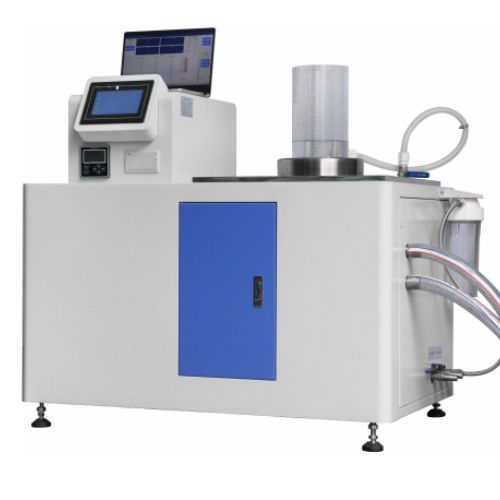
The geotextile vertical permeability tester is a constant head tester designed and manufactured according to the requirements of the latest national standard GB/T15789-2016. It is suitable for testing the vertical permeability of various permeable geotextiles and composite geotextiles under a constant head. The machine adopts microcomputer program control, and the sensor collects and measures the water volume, and the permeability coefficient is automatically calculated.
Standards:
GB/T15789-2016, ASTM D4491-2017 Method A - Constant Head Test.
Features:
1. Human-Machine Interface: Touchscreen operation, menu-driven, simple and clear operation.
2. Cooling Method: Imported compressor.
3. Protection Function: Built-in water level device with anti-dry-burning function.
4. Control Method: Microcontroller-based automatic temperature control.
5. Clamping Method: Vertical.
6. Built-in dissolved oxygen sensor for direct display of liquid oxygen concentration.
7. Built-in vacuum pump effectively reduces liquid oxygen concentration.
8. Water collection method: Flow meter or manual collection.
Technical Parameter:
1. Temperature Range: 15-30
2. Temperature Accuracy: 0.1
3. Water Collection Time: 30.0-999.9s (arbitrarily settable)
4. Oscillation Frequency: 20-70 times/min, stepless speed regulation
5. Head Difference: 0-250mm
6. Dissolved Oxygen Sensor Accuracy: 0.01mg/kg
7. Inner Diameter of the Aerator: 50mm0.2mm
8. Overall Dimensions: 12707501065mm
9. Power Supply: AC220V 50HZ 4000W
Advanced Dual Control and Data ManagementEffortlessly operate the tester via its LCD touchscreen or through a computer interface, with support for both USB and RS232 connections. The integrated PC software enables seamless data storage, export, and real-time curve monitoring, facilitating comprehensive analysis and traceability for laboratory personnel.
Precision Testing for Geotextile ApplicationsOptimized for determining the vertical permeability coefficient of geotextiles, this equipment handles single specimens with a 100 mm diameter and offers a wide test stroke of 0-250 mm. The adjustable test speed (1-99 mm/min) ensures accurate performance within a broad measuring range of 0.01-10 mm/s with 1% FS accuracy.
Built for Laboratory Efficiency and SafetyConstructed with high-quality stainless steel and high-transparency acrylic materials, the tester prioritizes durability and ease of observation. Over-voltage and over-current protections safeguard operations, while its compact benchtop design supports standard laboratory setups and consistent, reliable results.
FAQ's of Geotextile Permeability Tester DH-YT020M:
Q: How does the closed-loop circulation system benefit geotextile testing?
A: The closed-loop circulation system ensures consistent water flow and stable test conditions, reducing variability and enhancing the reliability of permeability measurements for geotextile samples.
Q: What are the main applications of the Geotextile Permeability Tester DH-YT020M?
A: This instrument is primarily used in laboratory settings to determine the vertical permeability coefficient of geotextiles and similar materials, crucial for civil engineering, construction, and environmental research.
Q: When and where should I use this permeability tester?
A: The DH-YT020M is designed for use within controlled laboratory environments where humidity ranges from 35-80% RH and temperatures between 15-35C. It is suitable for routine quality assurance or research testing of geotextile materials.
Q: What is the testing process using this machine?
A: A single specimen, 100 mm in diameter, is placed in the stainless steel sample holder. The automatic system allows users to set parameters such as test speed and stroke, then initiate the test via the touchscreen or connected computer. Results are displayed in real time and can be stored or exported for analysis.
Q: How does the device ensure user safety during operation?
A: Built-in over-voltage and over-current protections provide safe operation by preventing electrical surges or faults, safeguarding both the user and the equipment during lab tasks.
Q: What are the benefits of its software and connectivity features?
A: The PC software supports automatic data acquisition, result printing, real-time curve display, and simplifies the export of data for further analysis-enhancing documentation and traceability. USB and RS232 interfaces make it easy to integrate into modern laboratory workflows.
Q: Is the test speed adjustable and what is the range?
A: Yes, the test speed can be adjusted from 1 to 99 mm/min, allowing for customization based on material type and test requirements, thus ensuring precise and relevant outcomes.
 English
 Spanish
 French
 German
 Italian
 Chinese (Simplified)
 Japanese
 Korean
 Arabic
 Portuguese









 Send Inquiry
