Product Description
Application:
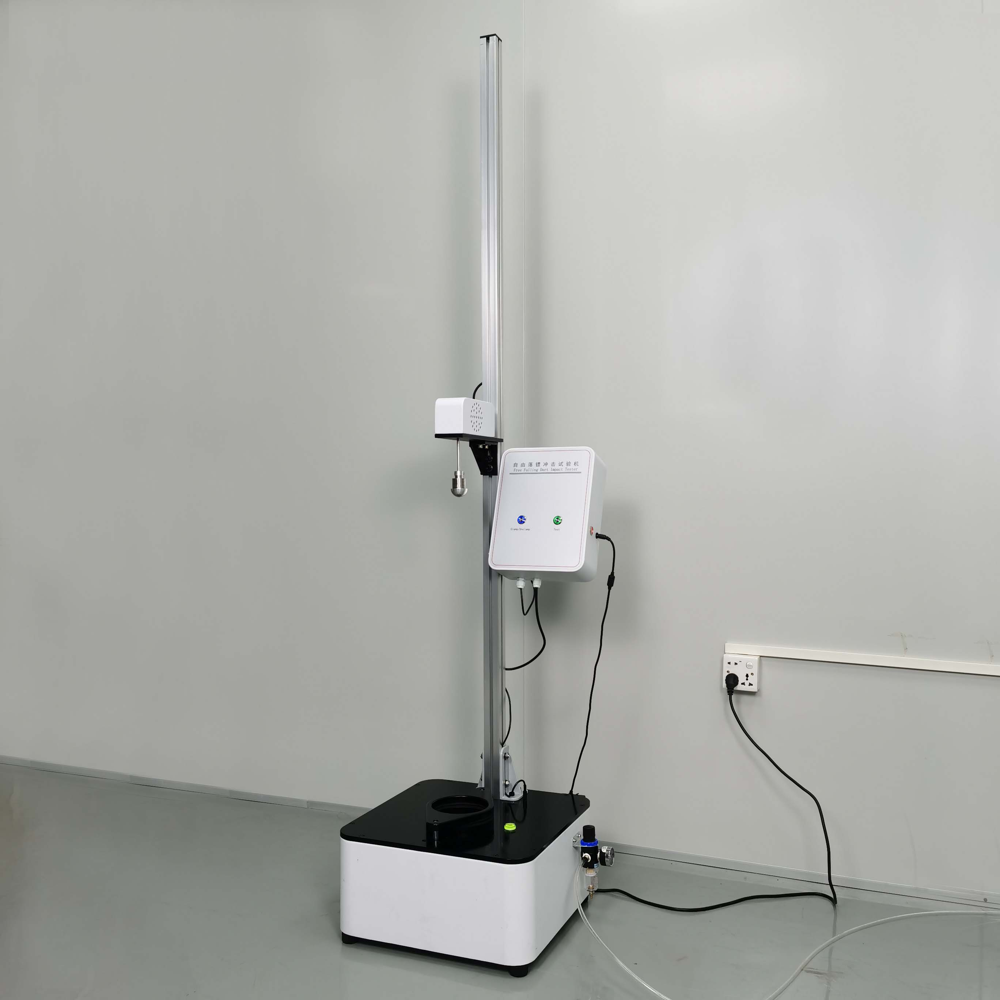
It is used to measure the impact mass and energy of 50% plastic film or sheet when the plastic film or sheet with a thickness of less than 1mm is impacted by a free falling dart at a given height.
Features:
l 2 test methods of A & B and automatic determination of testing status
l Electromagnetic suspension and automatic release of the falling dart reduce the errors caused by manual operation
l Pneumatic clamping, 2 starting modes of manual and pedal switch and built-in observation light are convenient to the user's operation
l Professional software supports multi-unit result display, graphic display of testing process and data export and printing
l Equipped with USB port and micro printer port which is convenient for data transmission and PC connection
Principle
Before starting the test, choose test method, and estimate an initial mass and m. Start the test. If the first specimen fails, decrease the mass of the falling dart by m. If the first specimen is not a failure, increase the mass of the falling dart by m. Continue the test according to this rule. In brief, increase or decrease by m according to whether the former specimen is a failure or not. After 20 specimens, calculate the total number of failed specimens N. If N equals to 10, the test is over. If N is less than 10, add specimens and continue to test until N equals to 10. If N is greater than 10, add specimen and continue the test until the number of non-failure specimens reaches 10. Then the tester calculates the test results automatically according to specific formulas.
Standards
This instrument conforms to various national and international standards:
ASTM D1709, ISO 7765-1-1988, JIS K7124-1, GB/T 9639.1-2008
Technical Specifications
|
Specifications
|
DH-BMC
|
|
Test Method
|
Method A,Method B
|
|
Test Range
|
Method A: 502000 g
Method B: 3002000 g
|
|
Accuracy
|
0.1 g (0.1J)
|
|
Specimen Clamp
|
Pneumatic Clamp
|
|
Pressure of Gas Supply
|
0.6 MPa (outside of supply scope)
|
|
Port of Gas Supply
|
8 mm PU Tubing
|
|
Specimen Size
|
> 150 mm x 150 mm
|
|
Power Supply
|
AC 220V 50Hz
|
|
Net Weight
|
50kg
|
|
Instrument Dimension
|
450*500*1500mm
|
Advanced Safety and ControlThe Falling Dart Impact Tester is equipped with a robust protective shield and an automatic cut-off system, ensuring user safety during every test. The microprocessor-based digital control offers precise and repeatable test operations, while the intuitive digital LED interface simplifies the user experience. The instrument also supports multi-language functionality, enhancing accessibility across diverse user groups.
Versatile Testing and ComplianceDesigned to comply with international standards such as ASTM D1709 and ISO 7765, this tester features interchangeable dart heads and adjustable drop heights for varying film types and thicknesses. With both vacuum and mechanical clamping, users can securely hold different samples, and the system performs accurate measurements within a test range of 5 g to 2000 g, making it suitable for wide-ranging industrial and research applications.
Connectivity and SupportFeaturing an optional RS232 port for computer connectivity, the Falling Dart Impact Tester allows seamless data output and analysis. The supplied calibration weights ensure ongoing testing accuracy, and the manufacturer offers both on-site and remote service support, aiding smooth operation and maintenance. Its flexible design can be tailored for automated sample loading and customizable fixture widths.
FAQ's of Falling Dart Impact Tester for Plastic Film Testing:
Q: How does the Falling Dart Impact Tester operate to measure plastic film impact resistance?
A: The tester drops a standardized dart from a preset height onto a clamped film specimen. The microprocessor-based control ensures precision, while detection systems instantly determine if puncture occurs. Test data can be manually recorded or outputted via the optional RS232 port for further analysis.
Q: What types of dart heads and fixtures are supplied with this tester?
A: Both type A and B dart heads are included to suit various testing requirements in accordance with ASTM D1709 and ISO 7765. Sample fixtures support either vacuum or mechanical clamping, accommodating different film properties and minimizing specimen slippage.
Q: When should the calibration process be performed, and how is it managed?
A: Calibration should be conducted periodically as recommended by standard laboratory practices or before critical testing sessions. The instrument is supplied with calibration weights, making the process straightforward and ensuring ongoing accuracy.
Q: Where can this impact tester be used, and what are its installation requirements?
A: The tester is suitable for quality control labs, research institutes, and manufacturing environments. It is a floor-standing or optional bench-top design, requiring a stable indoor location with AC 220V 50Hz power and ambient conditions between 10C and 40C with 20%-80% non-condensing humidity.
Q: What is the process for loading samples and conducting a test?
A: Samples are loaded into the clamp (manual or optional automatic loading), dart mass and drop height are set, and the test is initiated through the control panel. The dart is electromagnetically released, and results are displayed instantly on the digital LED panel.
Q: How does the equipment enhance testing efficiency and reliability?
A: With features like microprocessor control, adjustable drop heights, interchangeable darts, and automated sample release, the tester ensures repeatable and accurate results, reducing operator error and streamlining the testing workflow.
Q: What benefits do the safety features and digital controls offer to users?
A: The protective shield and auto cut-off ensure user safety during operation, while the digital control panel provides easy configuration and results display. The multi-language interface supports diverse users, making the equipment both secure and user-friendly.
 English
 Spanish
 French
 German
 Italian
 Chinese (Simplified)
 Japanese
 Korean
 Arabic
 Portuguese









 Send Inquiry
