Product Description
Introduction:
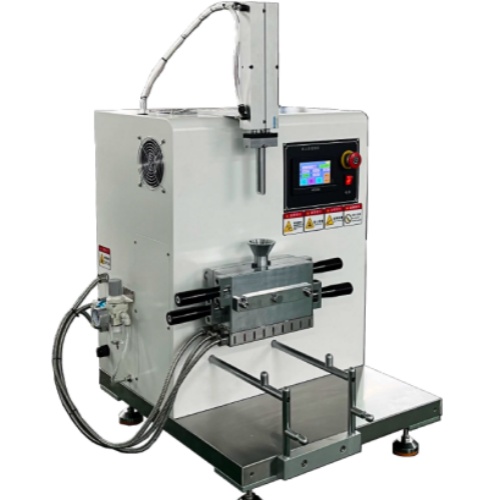
The main function of the desktop manual open and close internal mixer is to make the product meet the quality and color required by the customer. In order to meet the customer's requirements, the experimental results and their ratios are used in the production line. This machine is also the equipment for mixing the experimental raw materials and compounding agents evenly. It can be electrically heated and air cooled.
Parameters:
|
Model
|
HT-TM-05
|
|
Mixing chamber capacity
|
0.05L
|
|
Temperature range
|
RT-300
|
|
Heating method
|
Electric heating
|
|
Controller
|
PLC touch screen control
|
|
Rotor speed ratio
|
1:1.27
|
|
Rotor speed
|
Single frequency conversion speed regulation, 3-45 rpm adjustable
|
|
Feeding method
|
Manual
|
|
Rotor material
|
SKD Chrome-Molybdenum Alloy
|
|
Rotor hardness
|
HRC60 surface hard chrome
|
|
Mixing room
|
SKD chrome-molybdenum alloy material, inner surface hardness HRC60 mirror hard chrome
|
|
Upper pressure weight
|
Pneumatic
|
|
Main motor
|
2.2KW
|
|
Volume
|
550*550*1100MM
|
|
Power supply
|
380V,3 phase,or 220V single phase
|
|
Weight
|
Around 150kg
|
User-Friendly Touchscreen PLC ControlFeaturing a 7-inch touchscreen LCD, this table mixer provides intuitive and immediate control over all functions. The programmable speed range allows users to set mixing parameters accurately, supporting a wide variety of laboratory research and testing protocols with seamless operation.
Safety-First Design for Laboratory EnvironmentsIncorporating comprehensive safety features, such as emergency stop, overload protection, and an interlocked lid, this mixer is engineered to prioritize user protection. These mechanisms ensure safe operation, reducing the risk of accidental exposure or equipment damage during use.
Effortless Cleaning & MaintenanceThe stainless steel chamber is completely detachable, enabling straightforward cleaning and decontamination between batches. The design meets rigorous laboratory hygiene standards, minimizing cross-contamination and downtime due to maintenance.
FAQ's of 0.05L Table Mixer for Laboratory Material Mixing:
Q: How does the rotary blade/paddle mixing mechanism work in this laboratory mixer?
A: The rotary blade/paddle mechanism provides efficient and thorough blending by rotating at adjustable speeds (10-200 rpm). This ensures a high level of homogeneity (up to 95%) for powders or chemicals, making it suitable for various laboratory materials.
Q: What is the process for cleaning the mixing chamber after use?
A: The mixing chamber is detachable, allowing for easy removal and cleaning. Simply detach the chamber from the main unit, wash with appropriate cleaning agents, and reassemble for the next use. The stainless steel 304 construction supports hygienic and quick maintenance.
Q: When should I use the emergency stop feature?
A: The emergency stop feature should be used immediately if any unsafe condition or malfunction occurs during operation. Activating the emergency stop instantly halts the mixer to protect both the operator and equipment.
Q: Where can this laboratory mixer be installed?
A: This compact table mixer is designed for installation on a standard laboratory bench. With a footprint optimized for space-limited settings, it fits seamlessly into research laboratories, material testing facilities, and quality control environments.
Q: What are the main benefits of using this table mixer in the laboratory?
A: Key benefits include high-precision mixing, programmable speed control, comprehensive safety features, rapid cleaning, and compliance with CE standards. These contribute to consistent batch quality, user safety, and operational convenience.
Q: How does the PLC touchscreen control enhance the user experience?
A: The 7-inch touchscreen PLC interface allows for real-time adjustments and monitoring. It simplifies setting precise mixing parameters, improving experiment repeatability and saving time on manual adjustments.
Q: Is the mixer suitable for small batch and multiple sample mixing?
A: Yes, the mixer efficiently handles batch sizes from 10 ml up to 0.05 L and can mix up to two specimens per batch. This flexibility supports parallel sample preparation in research and testing workflows.
 English
 Spanish
 French
 German
 Italian
 Chinese (Simplified)
 Japanese
 Korean
 Arabic
 Portuguese










 Send Inquiry
