Product Description
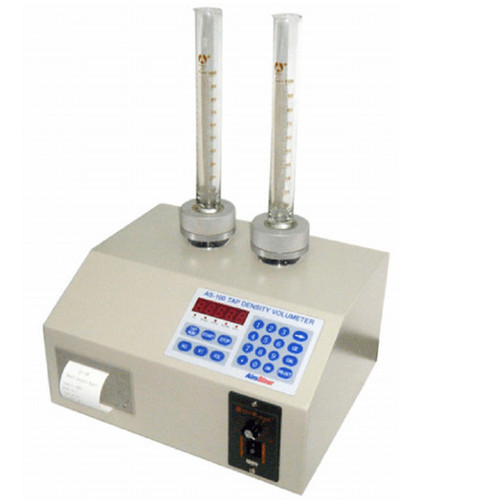
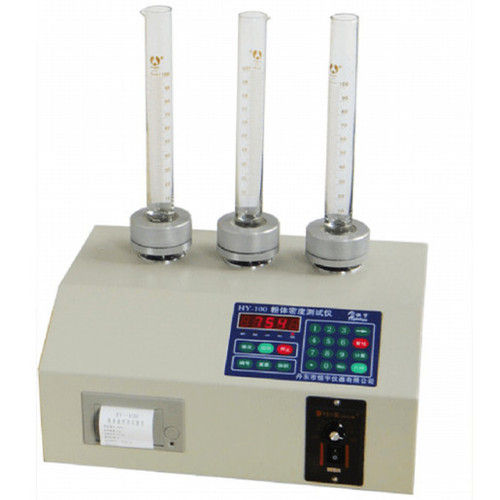
Tap Density Measurement Instrument
Powder density is the mass per unit volume.it can be classified as bulk density and tap density by different measuring method.Tap density tester is to measure the density of powder has been tapped or packed by standardized and repeatable procedures according to international standards.
Introduction:
DY-100A,B,C Powder density tester is based on GB/T5162-2006/ISO3953:1993,ASTM B527.For non-metallic powder,This instrument extended several functions.such as"vibration amplitude" from 3m standard extended to 1mm-15mm;"vibration frequency"from 100-300 times per minute extended to
0-300 times per minute."vibration times"from 3000 times standard extended to 0-99999 times.All of them can be setup freely.
DY-100A,B,C Powder density tester consist of adjustable-speed motor,vibration
assembly,micro-computer and micro printer.,etc.It has the feature of compact
structure,stable,and easy operation.,etc.
Specification:
(1)Weight of testing object: less than or equal to 500.00g
(2)Volume of testing object:less than or equal to250.00ml(standard accessory including
25ml,50ml,100ml,250ml measuring cylinder)
(3)Single vibration times:less than or equal to0-99999 times(the result will come out as bulk density when input zero times)
(4)Allowable motor force:0.86 N.m.
(5)Vibration frequency:maximum 300 round per minute(0-300 round per minute is adjustable,USA pharmacopeia standard is 300 round per minute)
(6)Vibration amplitude:maximum 15mm(1mm-15mm is adjustable,International standard is 3mm)
Features:
1.Drop Height-Easily Adjustment
The drop height is important for a tap density tester in order to meet different international standards.This tap density tester uses default 3mm height and some tapping washers in specific height to reach 14mm.They changes easily without opening the cover.
2.Working Panel-Intuitive
The intuitive LED and membrane working panel brings operator and easy and fast operation.Accurate to 4 decimals.Automatically saving all test information.Operator simply inputs the desired data and press start to test.
3.Rpm-Easily Adjustment
The rpm is also important for a tap density tester.This instrument uses a speed control to realize 250rpm and 300 rpm.The motor is default 300 rpm,just tun the knob and reach the right percentage to shift to 250rpm.
4.Analysis Result-Easily Printed
Integrated micro printer prints the test data after test including Sample No,weight,volume,tap number,tap density and operator.
5.Cover-Easily to Clean
The outer surface is plastic coated,it is strong and resistant to any powders non-corrosive or corrosive.It makes for the cleaning procedure as well as a longer working life.
Advanced Programmable Tap TestingThis instrument boasts programmable tap counts from 1 to 9999, enabling tailored test sequences for a variety of powder and granule types. Its digital microprocessor control simplifies operation, ensuring precise results and repeatable measurements. The real-time LCD display guides users through every step, making calibration and adjustments intuitive and efficient.
Dual Cylinder Capability and Safety EngineeringSimultaneously testing up to two standard cylinders (100 ml or 250 ml), the system increases laboratory throughput. Overload protection and an emergency stop button prioritize operator safety, while anti-vibration structure and feet minimize environmental interference. Powder coated mild steel construction ensures durability and resilience to laboratory conditions.
Accurate, Compliant, and VersatileSupplied with calibrated weight sets for density calibration, the instrument meets USP <616>, ISO 3953, and Ph. Eur. compliance criteria. Users benefit from a wide measuring range, high resolution, and accuracy appropriate for critical quality control applications. Its adjustable tap stroke options and bench-top mounting fit diverse laboratory workflows.
FAQs of Tap Density Measurement Instrument:
Q: How does the timer function operate in the Tap Density Measurement Instrument?
A: The programmable timer allows users to set the number of taps anywhere from 1 to 9999 using the microprocessor control and digital LCD interface. Once the desired tap count and test speed are set, the instrument automatically performs the sequence, stopping upon completion to ensure precise, repeatable results.
Q: What types of cylinders are supported, and what is the process for testing powders?
A: The instrument supports standard 100 ml and 250 ml glass cylinders. Users fill the cylinders with powder or granules, place them in the platform, select the appropriate test parameters, and initiate testing. Simultaneous measurement of up to two specimens is possible, enhancing laboratory productivity.
Q: When is density calibration required, and how is it performed?
A: Density calibration should be done periodically, especially before critical comparison tests or when switching cylinder types. The supplied calibrated weight set is used to verify and adjust the instrument, following the step-by-step calibration process outlined in the user manual.
Q: Where can this tap density measurement instrument be used?
A: Ideal for pharmaceutical, chemical, and material laboratories, the bench-top design fits most lab environments. Its robust construction and environmental specifications (operating at 10C to 40C and up to 80% humidity) accommodate a variety of settings in research, manufacturing, and quality control.
Q: What benefits does the vibration isolation feature provide during usage?
A: Vibration isolation, achieved through specialized feet and a reinforced structure, minimizes external disturbances, ensuring more consistent tap and density measurements. This leads to improved accuracy, especially important for quality assurance and standard compliance.
Q: How does the instrument ensure safe operation for laboratory staff?
A: Overload protection, emergency stop button, and a power consumption of 15 W support safe daily operation. These features, combined with a low operating noise level (<60 dB(A)), help create a secure and ergonomic workspace for operators.
Q: What standards of compliance and accuracy does this equipment offer?
A: The instrument complies with USP <616>, ISO 3953, and Ph. Eur., offering a measuring range of 0.0110 g/cm with an accuracy of 1% of full scale. This ensures results that meet international laboratory quality requirements.
 English
 Spanish
 French
 German
 Italian
 Chinese (Simplified)
 Japanese
 Korean
 Arabic
 Portuguese











 Send Inquiry