Product Description
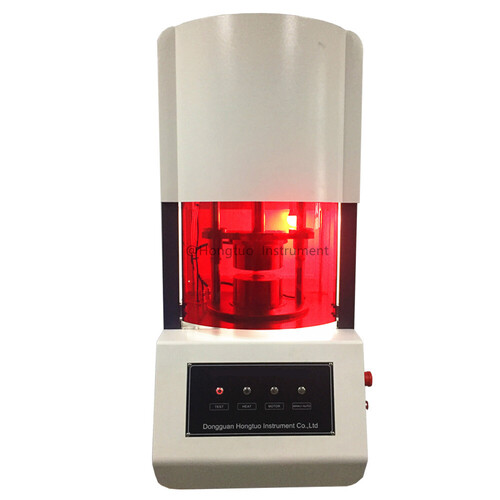
ASTM D 1646 Rubber Mooney Viscometer
Introduction
- High-precision sensor: 0 to 100 Mooney values. The Mooney Resolution: 1/10 Mooney
- Control system: computer control and interface board for data collection, preservation, processing and printing test results and curve processing.
- Temperature control system: Using Intelligent digital temperature control instrument, real-time Automatism adjusts PID control parameters. Temperature control range 0--200 degree, temperature resolution 0.1 degree.
- Data transmission method: RS232 transmission
- Measurement and control mode: humanized measurement and control method, mouse click-to-use or host panel touch button.
Main Technical Parameters
- Temperature range 0-200 degree
- Temperature Resolution 0.1degree
- Torque range 0-100 Mooney
- Measurement time 0-200 points Resolution 1 second
- Ambient temperature 0-35degree
- Gas distribution 0.45-0.6MPA
- Power supply AC 220V 1KVA
- Machine size: about 660*570*1300mm
- Machine weight: about 210Kg
Advanced Automation and Safety FeaturesThis viscometer offers fully automatic digital control with high operator safety. Overload and overheat protection prevent damage, while automatic rotor calibration ensures consistent accuracy. The robust design includes an integrated air-cooling system and uses high-grade hardened steel for the sample chamber, enhancing both performance and durability in demanding laboratory environments.
Intuitive Operation and Data ManagementUsers benefit from a clear LCD digital display, touch keypad with guided prompts, and simple manual sample loading with digital feedback. Data management is streamlined with a built-in printer, PC connectivity via RS232, and substantial storage capacity for up to 1,000 test results, ensuring traceability and easy reporting.
Reliable Testing for Rubber MaterialsSpecifically engineered for both natural and synthetic rubber, the instrument's 0-200 Mooney unit measuring range with 0.1 unit resolution suits R&D and quality control labs. Automatic temperature control up to 200C, rapid 3-second response, and high repeatability enable consistent and accurate Mooney viscosity readings every time.
FAQ's of ASTM D 1646 Rubber Mooney Viscometer:
Q: How does the Rubber Mooney Viscometer ensure test accuracy and consistency?
A: The viscometer employs a fixed 2 rpm rotor speed, automatic rotor calibration, and high-precision temperature control from room temperature up to 200C. These features, along with overload and overheat protection, guarantee accurate and repeatable Mooney viscosity measurements as per ASTM D1646.
Q: What is the process for loading samples into the viscometer?
A: Samples are manually loaded into a single specimen chamber. The instrument features a digital indication system that guides the operator, ensuring correct placement of specimens with standard size (44.5 mm diameter, 6 mm thickness) for reliable testing outcomes.
Q: When should calibration be performed on this instrument?
A: The equipment includes automatic rotor calibration, which can be initiated before test routines or according to laboratory protocol. Regular calibration ensures ongoing accuracy and helps maintain compliance with ASTM D1646 standards.
Q: Where can the Mooney Viscometer be installed for optimal performance?
A: This bench-top viscometer is best placed in controlled laboratory environments with ambient temperatures between 5C and 40C and humidity not exceeding 80% RH. Ample bench space and access to the 220 V AC power supply are required for secure installation and operation.
Q: How is data output and storage managed by the system?
A: The viscometer supports both direct printing and PC connectivity through an RS232 interface. Test results are automatically stored in the internal memory, with a capacity of up to 1,000 records, facilitating traceability and simplified data management for rubber analysis labs.
Q: What are the main benefits of using this Mooney Viscometer for rubber analysis?
A: Users gain highly reliable viscosity measurement for both natural and synthetic rubber materials, improved safety through multiple protection systems, intuitive digital controls, and efficient data handling. These advantages help laboratories achieve consistent quality control and accelerated research workflows.
 English
 Spanish
 French
 German
 Italian
 Chinese (Simplified)
 Japanese
 Korean
 Arabic
 Portuguese










 Send Inquiry